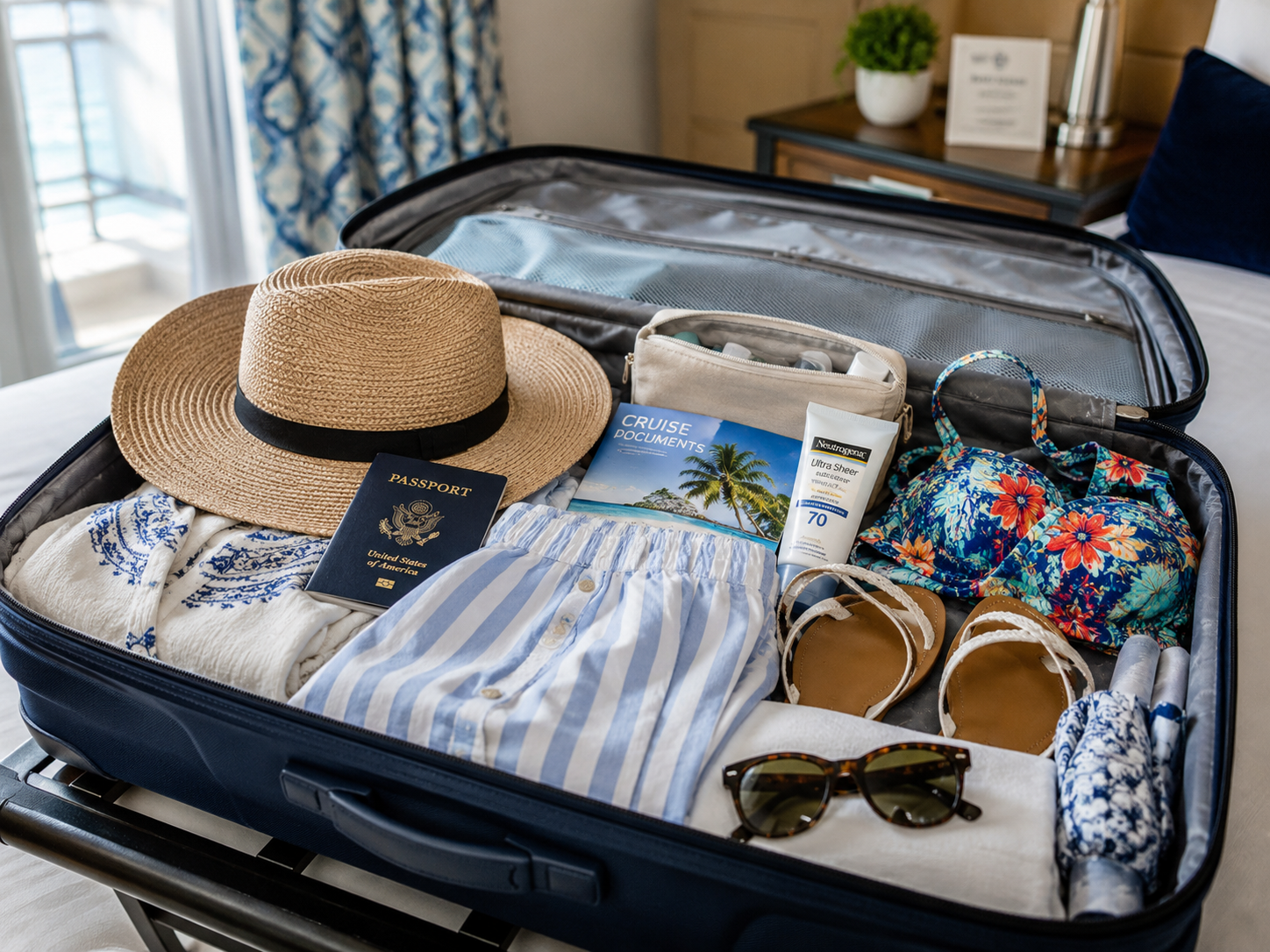
Pack for three kinds of day — pool-and-port, casual evening, and one or two dressier nights — and stop there. Cruise cabins are small, you'll wear less than you pack, and most ships have laundry. This guide, part of our New to Cruising guide, gives you the full printable checklist below.
The two things that separate a smooth first cruise from a stressful one aren't clothes: a well-stocked embarkation day bag (because your suitcase won't reach the cabin until evening), and a handful of cruise-specific items nobody tells you about — magnetic hooks, a key-card lanyard, a non-surge power strip. And a short list of things that will be taken off you at security.
Your embarkation day bag (the one that matters most)
Here's the detail that catches almost every first-timer: when you arrive at the terminal, you hand your big suitcases to a porter at the curb, and you won't see them again until they're delivered to your cabin door — often not until dinnertime, and on the biggest ships, late evening. Everything you need for the first half-day has to be on your shoulder.
If you pack only one bag with real care, make it the carry-on you keep with you at boarding. It's the difference between starting your cruise by the pool and starting it waiting outside your cabin.
Your day bag should hold the things you can't replace and the things you'll want in the first few hours: your passport and boarding documents, all prescription medications (never check these), any motion-sickness remedies, your phone and chargers, a swimsuit and sunscreen, and a change of clothes. Many cabins aren't ready until early afternoon anyway, so a packed day bag lets you head straight to the lido deck while everyone else hovers by the elevators. We walk through the full arrival sequence in our embarkation day guide.
The complete cruise packing checklist
This is the part to actually use. Tick items off as you pack, then hit Print / Save as PDF for a clean checklist you can take to the bedroom and fill the suitcase against. Nothing is saved or sent anywhere — it's yours. Starred (★) items are the cruise-specific ones first-timers most often forget.
Add your destination extras
Sailing somewhere specific? Tap a region to drop its extras onto the list below — they print and count too.
Documents & money
Health & toiletries
Daytime clothes
Evening & dressier nights
★ Cruise-specific items first-timers forget
Most of those starred items cost a few dollars and disproportionately improve the trip — the cabin storage gear especially, since standard cabins are tight on flat surfaces. If you'd rather buy them as a set, our cruise gear guide rounds up the magnetic hooks, lanyards, organizers, and chargers we'd actually pack (it's how the site keeps the lights on, but the picks are the ones we'd use ourselves).
Why those cruise-specific items matter
A few of the starred items deserve a sentence of explanation, because the reason isn't obvious until you're aboard.
Magnetic hooks. Cabin walls and the ceiling are steel, so a few strong magnetic hooks instantly create somewhere to hang wet swimsuits, hats, lanyards, and the daily schedule — storage the cabin otherwise doesn't give you. A key-card lanyard. Your cruise key card is your room key, your charge card, and your boarding ID for every port; a lanyard means it's never loose in a pocket when you're climbing back up the gangway. Power. Older cabins often have just one or two outlets, so a non-surge power strip or a multi-port USB block keeps everyone's devices charged — but read the next section first, because the wrong kind gets confiscated.
What NOT to pack
This is where independent advice beats a cruise line's own checklist: some popular "smart" packing items are banned outright and will be pulled from your bag at the security scan, then handed back on the last night (or, for some items, not at all). Knowing this before you pack saves a confiscation line at embarkation.
- Surge protectors. Banned on every major line — a real fire risk on a ship's electrical system.
- Power strips with surge protection, and on Royal Caribbean, all power strips and extension cords.
- Clothing irons & garment steamers. Fire hazard; use the ship's pressing service or launderettes instead.
- Candles, incense, hot plates, kettles. Anything with an open flame or heating element.
- Excess alcohol. Most lines allow a bottle or two of wine at most; the rest is held.
- A fresh outfit for every day. You'll re-wear more than you think; cabins are small.
- Beach towels. The ship provides pool and beach towels.
- A hairdryer. Cabins have one (weak, but there). Curling irons and straighteners are allowed.
- Heavy books / "just in case" gear. Weight you'll regret hauling up the gangway.
- Formal wear you'd never wear at home. One dressy outfit covers most itineraries.
Two clarifications worth keeping straight: hair dryers, curling irons, and flat irons are fine — it's only clothing irons and steamers that are prohibited. And policies do drift between lines, so if you're bringing any powered device, check your specific line's prohibited-items page. Confiscated items get tagged and returned to you, usually on your last night, but you don't want to start your cruise in that queue.
Packing by destination
The base checklist covers any sailing; what changes is the climate and the kind of port days you'll have. Caribbean cruising is about sun and water — extra reef-safe sunscreen, breathable clothing, water shoes for rocky beaches, and a dry bag for boat days. Alaska is the opposite: warm layers, a waterproof and windproof outer shell, sturdy walking shoes, and binoculars for glaciers and wildlife (still pack a swimsuit — the pools are heated). Mediterranean port days mean cobblestones and cathedrals, so comfortable walking shoes and shoulder-and-knee cover earn their place, and evenings skew a touch dressier. Northern Europe and the Baltic stay cool and changeable even in summer — layers, a waterproof jacket, and a compact umbrella.
Rather than make you copy any of that out, the checklist has a region selector built into the top of it: tap Caribbean, Alaska, Mediterranean, or Northern Europe and that region's extras drop straight onto your printable list, ready to print and tick off with everything else. If you're still choosing between the two most popular options, our Caribbean vs Alaska comparison covers the trade-offs beyond just the packing.
Before you zip the bag
Packing slots into a couple of other first-cruise calls. Forgetting items is one of the most-cited first-time cruise mistakes, and over-packing formal wear is near the top of that list — which is really a question of understanding the onboard dress codes so you bring the right one or two outfits, not five. If any cruise term in this guide is unfamiliar, the cruise glossary defines the lingo in plain English. And once you're packed, an excursion-day checklist handles the smaller bag you'll carry ashore.
Frequently asked questions
What should I pack for my first cruise?
Pack the documents and medications you can't replace at sea, clothes for three kinds of days (pool and port, casual evenings, and one or two dressier nights), and a small set of cruise-specific items most first-timers forget: a few magnetic hooks, a lanyard for your key card, a non-surge power strip or a multi-USB charger, and a day bag for embarkation. The full categorized checklist above covers everything and can be printed or saved as a PDF.
What should you not pack for a cruise?
Leave out anything that's a fire risk or will be confiscated at the gangway. Surge protectors are banned on every major line because a ship's electrical system can make them overheat, and clothing irons and steamers are prohibited too. Royal Caribbean has tightened its policy to ban even non-surge power strips and extension cords, so check your line. Also skip excess alcohol, candles, and most of the "just in case" clothing — cabins are small and you'll wear less than you think.
What do I need in my cruise carry-on bag?
Your checked bags are dropped with the porters at the terminal and may not reach your cabin until dinnertime, so your carry-on day bag should hold everything you need for the first several hours: passport and boarding documents, all prescription medications, any motion-sickness remedies, phone and chargers, a swimsuit and sunscreen, and a change of clothes. Treat it as the one bag that never leaves your shoulder.
Can you bring a power strip on a cruise?
Only a power strip with no surge protection, and only on lines that still allow them. Surge protectors are universally banned as a fire hazard. Several lines permit a plain non-surge power strip or a multi-USB charging block to deal with the one or two outlets in older cabins, but Royal Caribbean now prohibits power strips and extension cords entirely. A multi-port USB charging block that plugs directly into the wall (without an extension cord) is the safest choice that is accepted everywhere.
How many outfits do I need for a 7-day cruise?
Far fewer than you'd guess. For a week, plan roughly two or three daytime outfits you can mix and re-wear, five or six relaxed evening outfits, and one or two dressier looks for the formal or "elegant" nights. Pack a swimsuit or two, comfortable walking shoes for ports, and one nicer pair for the evening. Cabins are compact and all ships offer paid laundry (and many have self-service launderettes), so many passengers resist the urge to pack a fresh outfit for every day.
What should you not wear on a cruise?
Most of the ship is casual by day, but the main dining room has a dress code at dinner, and on formal nights swimwear, gym clothes, tank tops, and flip-flops are usually turned away. Bring at least one outfit that clears the bar — a collared shirt and slacks, or a dress or jumpsuit. Our cruise dress code guide breaks down what each line actually enforces so you don't over- or under-pack.