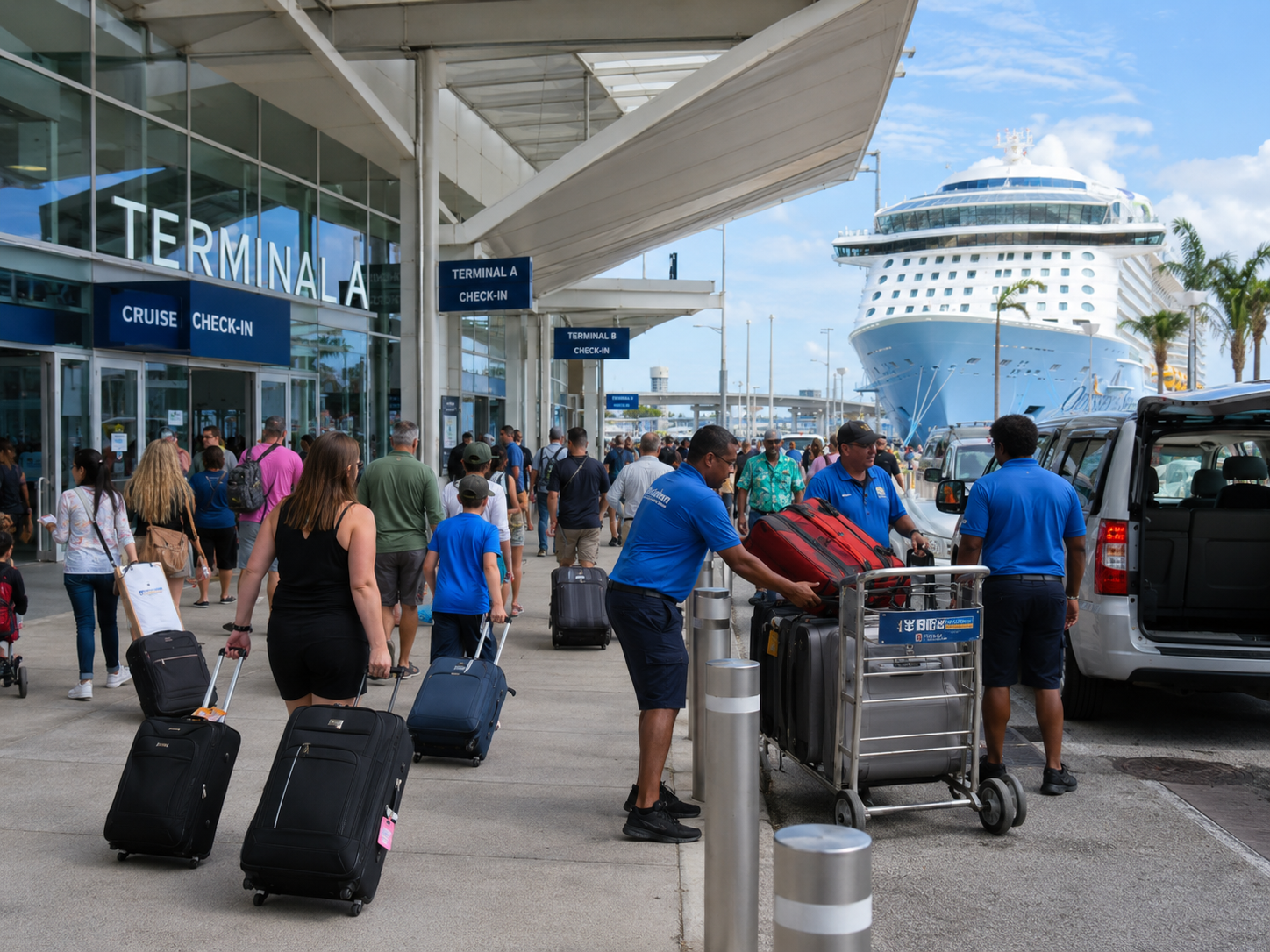
Embarkation day is the first day of your cruise — the day you board. The boarding process is a predictable sequence: hand your bags to a porter at the curb, clear security, check in with your documents, board when your group is called, settle in while your cabin is prepared, complete the mandatory muster drill, and sail away. Plan to arrive at the start of your assigned boarding window (for most cruisers between roughly 11 a.m. and 1 p.m.), and keep everything you'll need for the first few hours in a carry-on, because your checked luggage won't reach your cabin until later in the afternoon.
This guide, part of our New to Cruising guide, walks you through the whole day step by step — what to do before you arrive, the hour-by-hour timeline at the terminal, the first hours aboard, and the muster drill no one can skip.
Before you arrive: online check-in and your arrival appointment
Most of embarkation day is won the week before, at a laptop. Once online check-in opens — usually somewhere around 30 to 45 days before sailing, depending on the line — log in promptly and complete it. You'll upload your photo, enter your passport or birth-certificate details, register a credit card for your onboard account, and, crucially, choose your arrival appointment. The best windows go first, so booking early gives you a real say in when your day starts.
While you're at it, print your luggage tags (or have the line mail them, on some ships) and attach one to each checked bag. A tagged bag with your cabin number on it is delivered faster and with less chance of going astray. Have your passport or cruise documents and a government photo ID somewhere easy to reach — you'll need them within minutes of arriving. If you're flying in, remember the most important timing rule of all isn't on embarkation day itself: get to the port city the day before you sail so a delayed flight can't cost you the whole cruise.
Embarkation day, hour by hour
Here's how a typical North American embarkation day unfolds from curb to cabin. Your exact times are printed on your cruise documents and in the line's app, so treat this as the shape of the day rather than a fixed schedule — the rhythm is remarkably consistent across the major lines.
| When | What's happening | What to do |
|---|---|---|
| ~10:30–11:00 AM | Terminal opens once the previous sailing has fully disembarked. | No need to be here yet unless this is your window. |
| At the curb | Porters take your large suitcases for delivery to your cabin. | Tip the porter; keep your carry-on with you. |
| Your boarding window (often 11 AM–1 PM) |
Security screening, then document check and check-in. | Arrive at the start of your window with ID and documents in hand. |
| After check-in | You wait briefly in a lounge until your boarding group is called. | Have your cruise card or app ready; walk aboard. |
| ~1:00–2:00 PM | Cabins are usually ready; the buffet is open for lunch. | Drop your carry-on, eat, explore the ship. |
| Before sailing | Muster drill — mandatory safety check-in for all guests. | Complete your muster drill at your assigned station. |
| ~3:00–6:00 PM | Checked luggage is delivered to cabins; sail-away begins. | Enjoy the sail-away party; unpack as bags arrive. |
General pattern for North American embarkation. Your assigned window, muster procedure, and sailing time are on your cruise documents and vary by ship and port.
The security and check-in steps feel a lot like an airport: a quick screening, then a port agent verifies your boarding pass, photo ID, and citizenship documents. With online check-in done in advance, the whole curb-to-aboard process often takes just 15 to 30 minutes. The biggest variable is timing — arriving at the start of your window, rather than in the noon crush, is the difference between walking straight on and standing in the day's longest line. For the related question of how early to get to the port city in the first place, see our guide on when to arrive for your cruise.
Your first hours aboard (and why your cabin isn't ready)
Here's the thing that surprises almost every first-timer: you board, you're excited to see your room — and the cabin hallway is roped off. That's normal. The crew has spent the morning turning over thousands of cabins after the previous guests left, and staterooms generally aren't ready until early afternoon, around 1:00 to 2:00 p.m. An announcement lets everyone know when all cabins are open. Until then, the worst move is to hover outside your door while your cabin steward is still working; the best move is to go enjoy the ship.
This is exactly why your carry-on matters. Your checked bags are off with the porters and won't appear at your cabin until mid-afternoon to evening — sometimes after the ship has already sailed. So the first afternoon belongs to whatever you carried on: head to the buffet for lunch, walk the deck, find the pool, locate your dining room and the theater, and get your bearings. If you booked any tours, the ship's cruise director and the daily program will point you to the first-day activities and any shore-excursion talks.
"Pack your first afternoon into your carry-on, not your suitcase. Medications, documents, swimwear, a phone charger — if you'll want it before dinner, it should be on your shoulder, not somewhere in a porter's luggage cart."
A short, well-packed carry-on is the single habit that separates a smooth embarkation from a stressful one. Forgetting it — and then waiting hours for a suitcase with your medication or your dinner clothes in it — is one of the classic first-time cruise mistakes. Our cruise packing list covers exactly what belongs in that day-one bag, and if you want a dedicated bag for it, our cruise gear guide rounds up packable carry-ons and embarkation-day essentials.
The muster drill: the one thing you can't skip
At some point before the ship sails, every passenger must complete the muster drill — a legally required safety briefing that shows you where to go and what to do in an emergency. It is genuinely mandatory; the crew tracks who has checked in, and the ship will not leave passengers unaccounted for.
The good news is that it's quick now. Most lines have moved to an e-muster: you watch a short safety video on the line's app or your stateroom TV, then walk to your assigned muster station — printed on your cruise card — to be scanned in. The whole thing takes only a few minutes, and you can do it any time after boarding rather than standing in a crowd at a fixed hour. A handful of ships still run the traditional all-passenger drill, where everyone reports to their station together at a set time. Either way, get it done early so it doesn't interrupt your sail-away party. (For the formal definitions of these terms, see embarkation and disembarkation in the glossary.)
Getting to the terminal — and what comes next
How you reach the terminal shapes the morning. If you're driving, factor in port parking and the walk from the lot. If you flew in and stayed nearby, a pre-arranged transfer or rideshare drops you right at the curb where the porters are waiting — confirm the pickup time leaves margin for traffic. Either way, your bags go to a porter the moment you arrive, so you're walking into the terminal hands-free. The departure city's hotels, parking, and airport logistics are covered port by port in our embarkation port guides.
If your itinerary includes a shore day you want to plan in advance, embarkation day is a fine time to lock in tours — many travelers book day-one and early-port shore excursions before they sail so the best ones don't sell out. And once your first day is behind you and you're settled in, the natural next read is the rest of the cruise glossary to decode the onboard lingo, or a look at planning your embarkation-day outfit so you're dressed for the curb, the pool, and dinner all in one go.
Frequently asked questions
What is embarkation day on a cruise?
Embarkation day is the first day of your cruise — the day you board the ship at the departure port. "Embarkation" simply means boarding; disembarkation is the reverse, the day you get off. In practice it's a sequence of steps: hand your luggage to a porter at the curb, pass through security, present your documents at check-in, board when your group is called, settle in while your cabin is prepared, complete the mandatory muster drill, and watch the ship sail away. The whole boarding process usually takes between 30 minutes and a couple of hours depending on the crowd and how much check-in you completed online. See the hour-by-hour timeline above.
What time can you board the ship on embarkation day?
Terminals generally open for boarding in the late morning, often around 10:30 to 11:00 a.m., once the previous sailing's guests have all disembarked. Most lines now assign or let you pick a staggered arrival appointment during online check-in, so the right time to show up is the start of your assigned window rather than as early as physically possible. Boarding continues through the afternoon and closes roughly 60 to 90 minutes before departure — that all-aboard deadline, not the departure time itself, is the one to respect.
Are cabins ready when you first board the ship?
Usually not right away. Staterooms are typically ready between about 1:00 and 2:00 p.m., because the crew needs time to clean and turn over every cabin after the previous guests leave that morning. If you board earlier, your cabin door may still be closed — so keep your carry-on with you, grab lunch, and explore the ship until the captain announces that all cabins are ready. Camping outside a not-yet-ready cabin just gets in the cabin steward's way.
Is the muster drill mandatory on embarkation day?
Yes. The muster drill is a legally required safety briefing every passenger must complete before the ship sails, and the crew tracks who has and hasn't checked in. Most lines now run an e-muster: you watch a short safety video on the app or your stateroom TV, then visit your assigned muster station to be scanned in, which takes only a few minutes. A few ships still hold a traditional group drill. Either way it's not optional, and the ship will chase down anyone who hasn't completed it.
What should I keep in my carry-on on embarkation day?
Anything you'll need before your checked luggage arrives at your cabin, which can be late afternoon or early evening. That means medications, travel documents and ID, a change of clothes or swimwear, sunglasses, phone chargers, and any valuables. Your big suitcases go to a porter at the curb and are delivered over the following hours, so don't pack day-one essentials in them. Our cruise packing list breaks down exactly what belongs in that day-one bag.
When does my checked luggage arrive at my cabin?
Checked bags handed to a porter at the terminal are typically delivered to your stateroom from mid-afternoon through the evening, often between about 3:00 and 6:00 p.m., though large ships can run later. Delivery is staggered across thousands of bags, so it's normal for yours to arrive after the ship has already sailed. This is exactly why a carry-on with your essentials matters — you may be at the muster drill and the sail-away party before your suitcase shows up.