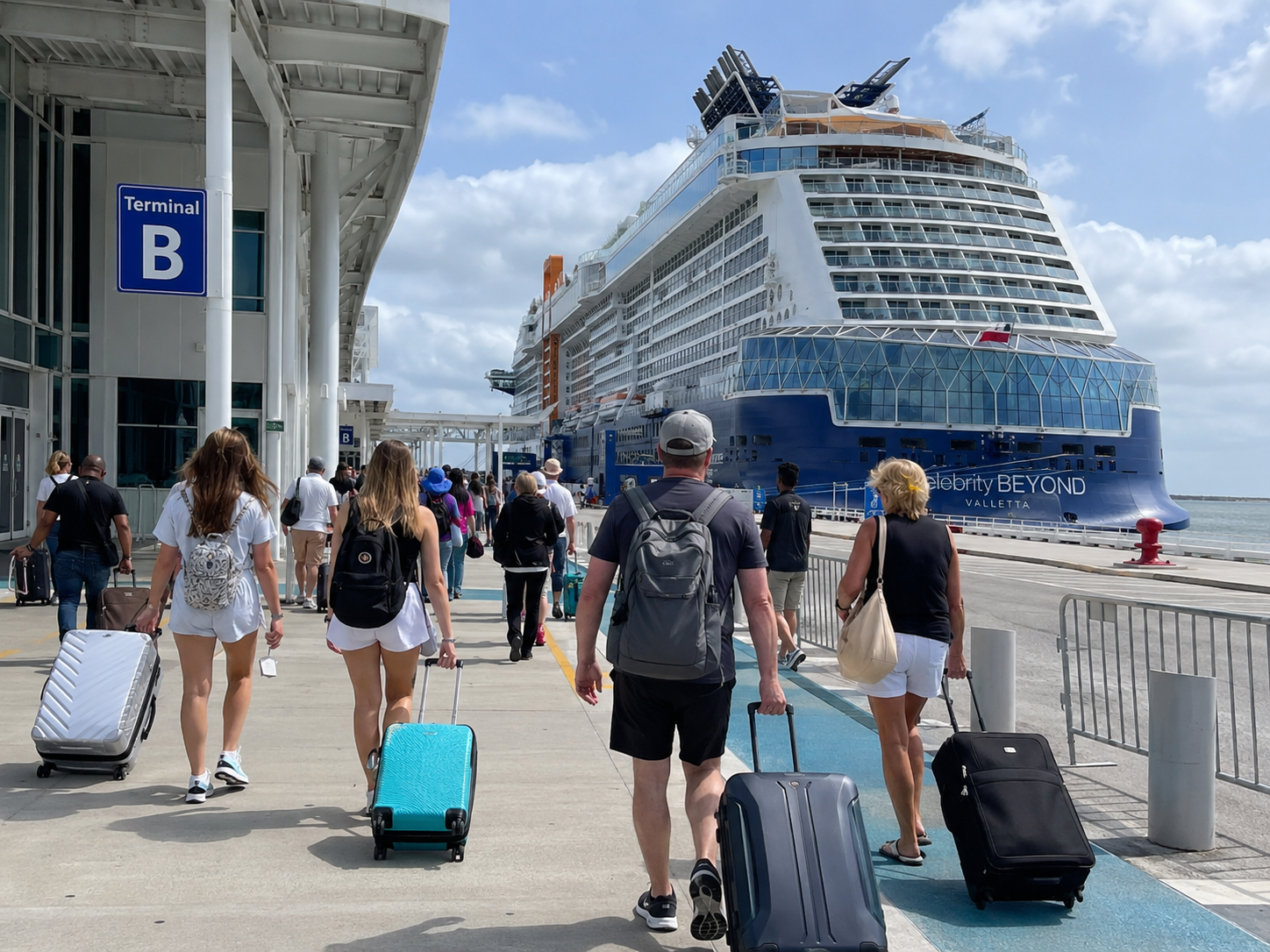
Get yourself to the embarkation city the day before you sail — this is the single most important timing decision you'll make, and flying in the same day is the most common way first-timers actually miss the ship. On embarkation day itself, arrive at the terminal at the start of your assigned boarding window (for most cruisers somewhere between 11 a.m. and 1 p.m.), and be physically aboard at least 60 to 90 minutes before departure, which is usually late afternoon.
The ship does not wait. This guide, part of our New to Cruising guide, walks through the day-before rule, the real embarkation-day timeline, what to do if you genuinely can't avoid a same-day flight, and how early to book your trip home.
Fly in the day before — this is the rule that matters
If you take one thing from this page, take this: arrive in your embarkation city at least one full day before the ship sails. Every other timing question on this page is minor next to it. A cruise has exactly one departure, from one port, at one time — and if you're not there, it leaves without you. There is no later flight that fixes a missed sailing the way it fixes a missed connection.
Same-day air travel is where the trouble starts. A delayed or cancelled flight, a missed connection, weather over a hub a thousand miles away — any of these on embarkation morning can put the ship over the horizon before you clear baggage claim. Arrive the night before and those same disruptions become a survivable inconvenience: you have the evening and the next morning to rebook and still make it to the pier.
"The night-before hotel is the cheapest travel insurance you'll ever buy. The alternative to it isn't 'a little stress' — it's flying to the next port at your own expense to chase a ship you already paid for."
The math is lopsided. A pre-cruise hotel night is a modest, known cost. Missing the ship means a last-minute flight to the first port of call, an unplanned hotel there, and a day or two of your vacation gone — assuming the itinerary even allows a catch-up. Many experienced cruisers go further and fly in two nights early for winter sailings or long-haul connections, where weather risk is higher. As a bonus, an extra day lets you actually see the embarkation city instead of sprinting through it.
The honest exceptions are narrow: a short, low-traffic drive to a nearby home port, or — as a deliberate last resort — an early, direct morning flight with hours of cushion. Booking through the cruise line's own air-sea package can add some protection, since the line has more incentive to get you to the ship, but it still doesn't beat simply being there a day ahead.
Embarkation day: when boarding opens and when "all aboard" is
Once you're in the port city, embarkation day runs on a predictable rhythm. Boarding generally opens late morning and check-in is staggered, so the instinct to "get there as early as possible" mostly earns you a longer wait in the terminal. Aim for the start of your assigned window instead — early enough to enjoy a full first day aboard, not so early that your cabin isn't ready and the gangway isn't open.
Here's how a typical embarkation day unfolds. Your exact times are printed on your cruise documents and in the line's app, so treat this as the shape of the day rather than a fixed schedule:
| When | What's happening | What to do |
|---|---|---|
| Night before | You're already in the embarkation city. | Sleep near the port; complete online check-in if you haven't. |
| ~10:30–11:00 AM | Terminal opens; earliest guests begin boarding. | No need to be here yet unless this is your window. |
| Your boarding window (often 11 AM–1 PM) |
Staggered check-in by deck, cabin, or chosen slot. | Arrive at the start of your window. Hand bags to a porter. |
| ~1:00–3:30 PM | Cabins are usually ready; lunch is being served. | Drop your carry-on, eat, explore the ship. |
| 60–90 min before sailing |
All-aboard deadline. The gangway closes. | Be physically on the ship — this is your real deadline. |
| Late afternoon (often 4–5 PM) |
Muster drill, then sail-away. | Complete your muster drill check-in, then enjoy the departure. |
General pattern for North American embarkation. Your assigned window, all-aboard time, and sailing time are on your cruise documents and vary by ship and port.
Two deadlines are easy to confuse, and only one matters. The departure time is when the ship leaves; the all-aboard time, typically 60 to 90 minutes earlier, is when every passenger must be on board. Plan around the all-aboard time, not the departure time. When you hand your checked luggage to a porter at the curb, it's delivered to your cabin later in the afternoon, so keep medications, documents, and anything for the first few hours in a carry-on. If you've pre-booked airport-to-port transfers, confirm the pickup time leaves margin for traffic.
If you absolutely must fly in on embarkation day
Sometimes the day-before hotel isn't possible. If you have to fly in the morning of, treat it as a calculated risk and stack the odds in your favor rather than hoping for the best.
- Take the earliest direct flight you can. The first flight of the day has the best on-time record and the most rebooking options if it's cancelled. Avoid connections entirely — every connection is another chance to be stranded.
- Demand a real cushion. A useful rule of thumb is to be on the ground at the embarkation airport no later than early afternoon, several hours before the all-aboard time — enough to absorb a delay, clear bags, and still reach the terminal.
- Know the ship's all-aboard time before you book the flight, not after. Work backward from it.
- Have a Plan B in your pocket. Know which port the ship visits next and roughly what it would cost to get there, so a missed sailing is a decision, not a panic.
Even done well, same-day flying carries risk the day-before approach simply removes. It's a last resort, not a money-saving strategy — underestimating travel-day risk is one of the classic first-time cruise mistakes. While you're sorting logistics, it's also the moment to make sure your cruise documents and passport are in order and that everything you need for the first few hours is in your carry-on bag rather than checked luggage.
The other arrival question: booking your flight home
The day-before rule has a mirror image on the back end. Disembarkation morning is slower than people expect: the ship clears customs and releases guests in waves, typically wrapping up around mid-morning, and then you still have the terminal-to-airport transfer and check-in ahead of you. Booking a flight too early is how a relaxing week ends in a sprint.
For domestic flights, don't book anything before about noon, and early afternoon is more comfortable. For international flights with customs and longer check-in, aim later still — or, the cleanest option, add a night in the disembarkation city and fly out rested the next day. If you must catch an earlier flight, ask about self-disembarkation (carrying your own bags off first thing), which can get you ashore sooner. Where you sleep the night before the cruise and the night after it is part of the bigger picture in our embarkation port guides, which cover hotels and airport logistics by port.
Once your arrival timing is settled, the natural next read is the embarkation day walkthrough — what actually happens from curb to cabin once you're at the terminal. And if any of the terminology here is new, our cruise glossary defines the lingo in plain English.
Frequently asked questions
What time can you board a cruise ship on embarkation day?
Boarding usually begins between about 10:30 a.m. and noon, depending on the ship and port, and continues until roughly 60 to 90 minutes before departure. Most lines now assign or let you choose a staggered boarding window during online check-in, so the practical answer is to arrive at the start of your assigned window rather than as early as physically possible. Showing up at 8 a.m. just means waiting in the terminal — your cabin won't be ready and the ship may not be open for boarding yet.
How early should you arrive at the cruise port?
On embarkation day, plan to be at the terminal at the start of your assigned boarding window — for most cruisers that's somewhere between 11 a.m. and 1 p.m. If you haven't been given a window, aim to arrive after noon and no later than about two hours before the scheduled departure. More importantly, get yourself to the embarkation city the day before you sail; arriving the day of, especially by air, is the single biggest avoidable risk to your whole trip. See the embarkation-day timeline above.
Should I fly in the day before my cruise?
Yes — flying in at least one day before embarkation is the strongest single piece of advice for any cruiser flying to the port. A delayed or cancelled flight on embarkation day can mean missing the ship entirely, because the ship won't wait. Arriving the night before gives you a buffer to rebook if something goes wrong, and the cost of a pre-cruise hotel is small next to a last-minute flight to catch the ship at its next port — or a lost cruise. The only times skipping it is reasonable are a short, low-risk drive to a nearby home port, or an early, direct morning flight with a long cushion as a deliberate last resort.
What happens if I arrive late and miss the ship?
The ship sails without you. Cruise departure times are firm, and the gangway closes 60 to 90 minutes before the posted sailing time, so arriving even a little late at the terminal can mean being left at the pier. If you miss embarkation, you're responsible for getting yourself to the next port of call at your own expense to join the ship there. This is exactly why arriving the day before — and being aboard well inside the all-aboard deadline — matters: there's no grace period and no refund for a missed sailing.
What time does a cruise ship leave port?
Most cruises depart in the late afternoon or early evening, frequently between about 4 and 5 p.m., though it varies by ship and itinerary and your specific time is printed on your cruise documents. The all-aboard time — when every passenger must be physically on the ship — is typically 60 to 90 minutes before that. Treat the all-aboard time, not the departure time, as your real deadline, and build in margin for traffic, security lines, and the muster drill.
How early should I book my flight home after a cruise?
Give yourself plenty of room on disembarkation morning. The ship typically clears for everyone to leave somewhere around 9 to 10 a.m. after customs processing, and the terminal-to-airport transfer plus check-in adds hours. For domestic flights, don't book anything before about noon, and many cruisers prefer early afternoon; for international flights, aim later still, or simply add a night in the disembarkation city. A self-disembarkation option, where you carry your own bags off early, can buy you an earlier flight — but a same-morning rush is the kind of avoidable stress that ends a good trip badly.