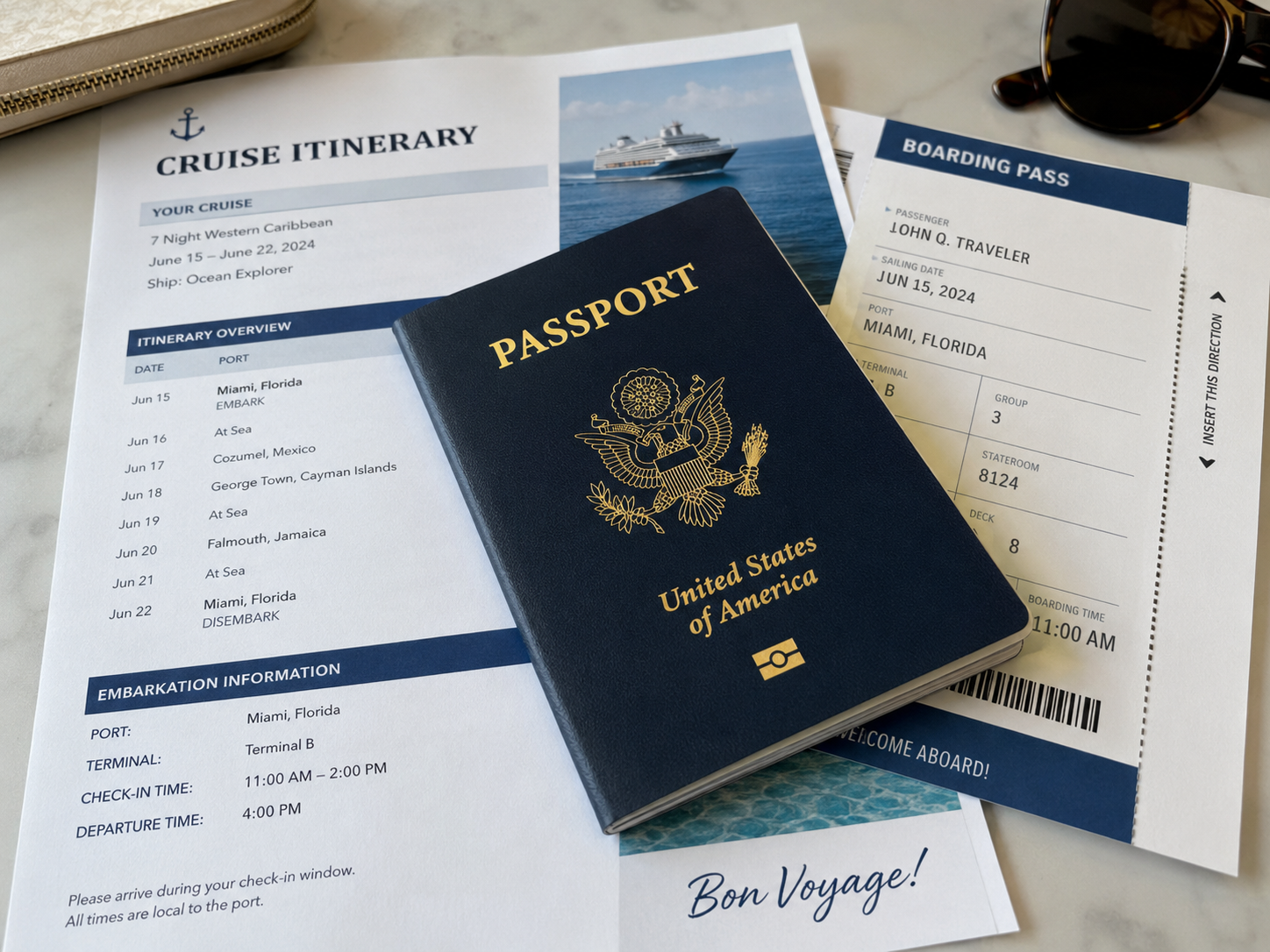
If you're a U.S. citizen on a closed-loop cruise — one that starts and ends at the same U.S. port — you don't legally need a passport. A certified birth certificate plus a government photo ID is enough to board and re-enter the country. For everything else — one-way sailings, cruises that start or end abroad, and itineraries visiting countries that require a passport — a passport book is required.
But "not required" and "a good idea" aren't the same thing. Our honest take, below, is that you should bring a passport book regardless, and this guide — part of our New to Cruising guide — explains why, with a clear table of what each itinerary actually demands and the rules for kids.
The closed-loop rule that lets you cruise without a passport
Most first-timers are surprised they can cruise the Caribbean on a driver's license and a birth certificate. The reason is a federal rule called the Western Hemisphere Travel Initiative (WHTI), which carves out an exception for closed-loop cruises — sailings that depart from and return to the same U.S. port, like a round-trip out of Miami, Galveston, or Seattle.
On a closed-loop cruise, a U.S. citizen can travel with any one of these instead of a passport book:
- A valid U.S. passport book (always the simplest option), or
- A U.S. passport card, or
- A certified birth certificate (issued by a state, county, or city vital-records office) plus a government-issued photo ID such as a driver's license, or
- A Trusted Traveler card such as NEXUS.
Two details trip people up. First, the birth certificate has to be an official government-issued copy — a hospital "keepsake" certificate or a baptismal record won't be accepted at the pier. Second, the WHTI exception only covers the cruise itself; it does not help you board a flight home from a foreign country if your trip goes sideways. Hold onto that point — it's the whole basis for our recommendation later. If any of the terminology here is new, our cruise glossary defines the lingo in plain English.
Passport requirements by itinerary type
The single question that decides everything is what your itinerary does at its endpoints. Here's the document each common scenario actually requires for a U.S. citizen:
| Your itinerary | Passport required? | Accepted documents |
|---|---|---|
| Closed-loop cruise (round-trip from one U.S. port) |
No (technically) | Passport book or passport card or certified birth certificate + government photo ID |
| One-way or repositioning (different start & end port) |
Yes | Passport book |
| Starts or ends in a foreign port |
Yes | Passport book |
| Visits a country that requires a passport to enter |
Yes | Passport book (+ any required visa) |
| Children under 16 on a closed-loop cruise |
No | Certified birth certificate (photo ID not required) |
| Any cruise, if you'd need to fly home in an emergency |
Strongly advised | Passport book |
For U.S. citizens. Document rules are set by the cruise line and U.S. Customs and Border Protection; confirm your specific sailing's requirements with your line before you travel.
Notice the bottom row. Even when a passport isn't legally required, the realistic risk — missing the ship in a foreign port, or a medical situation that sends you home early — turns it into the document that actually protects your trip. Where your cruise stops (and whether those stops are passport-required) is part of researching your itinerary in our embarkation and port guides.
Our honest take: bring the passport book anyway
The internet is full of advice technically true and practically risky: "you don't need a passport, so save the money." We disagree, and here's the reasoning rather than just the verdict.
- You're on a closed-loop cruise and genuinely cannot get a passport in time.
- You have no realistic way to be flown home early (and you're comfortable with that risk).
- It's a short, nearby sailing and the savings matter more than the flexibility.
- There's any chance you'd need to fly home from a foreign port — illness, a family emergency, or simply missing the ship.
- Your itinerary isn't strictly closed-loop, or visits a passport-required country.
- You'd rather not gamble your vacation on a document loophole to save a modest fee.
The scenario that matters is the one nobody plans for: the ship sails, and you're not on it — left behind at a port in Mexico, the Bahamas, or further afield. To get home, you have to fly. A birth certificate can't board a plane, and neither can a passport card. Only a passport book gets you on that flight. The same is true of a medical evacuation or a need to leave the cruise early.
"A passport book is a ten-year document that costs a fraction of your cruise fare. The one time you need it, no other piece of paper will do — and you won't know in advance that it's the day you needed it."
Skipping the passport to save a little is, predictably, one of the more consequential first-time cruise mistakes. The same emergency logic is why we treat travel protection seriously, too — it's worth weighing whether cruise travel insurance is worth it alongside getting the passport, since both exist for the same "something went wrong far from home" moment.
What about children?
Kids get a small break from the adult rule. On a closed-loop cruise, children under 16 can travel on a certified birth certificate alone — no photo ID required, which makes sense, since they usually don't have one. Teens aged 16 and 17 follow the adult standard: birth certificate plus a government photo ID.
The exceptions still apply to everyone, though. If the cruise requires a passport for adults — one-way, foreign-port, or a passport-required destination — children of all ages need a passport book too. And the emergency argument is, if anything, stronger for families: getting a child flown home without a passport is exactly the situation you don't want to discover at a foreign pier. One bonus for parents — a child's passport is valid for five years and costs less than an adult's, so it's a low-stakes addition to the family travel kit.
Passport card vs. book, validity, and the flight to the port
A few document details that quietly cause problems:
- Passport book vs. passport card. The card is cheaper and works for land and sea travel within the Western Hemisphere, so it satisfies the closed-loop rule — but it cannot be used for air travel. For cruisers, that limitation defeats the entire point of carrying a backup document. Get the book.
- The six-month validity rule. Many countries require your passport to remain valid for at least six months beyond your trip's end (some require three). If yours expires within six months of your return date, renew it before you sail — an expiring passport can get you turned away at boarding or at a port.
- REAL ID for the flight to your port. If you're flying to your embarkation city, U.S. domestic flights now require a REAL ID-compliant driver's license or a passport — REAL ID is fully enforced. A current passport book covers this automatically, one more way it simplifies the whole trip.
- Visas. A handful of itineraries — certain stops in places like Brazil, India, or China on world and exotic sailings — require a visa arranged in advance, separate from your passport. Your cruise line will flag these, but confirm early since visas take time.
Getting your documents sorted is genuinely the first thing to handle once you book. It pairs with two other early tasks: deciding when to arrive for your cruise (and whether to fly in the day before) and building your cruise packing list, where your passport and a waterproof document holder belong at the very top. A simple passport and document organizer is a small thing that keeps everyone's papers together on embarkation day.
When the day comes, your documents are the very first thing checked at the terminal — it's step one of the whole embarkation day process.
Frequently asked questions
Do you need a passport to go on a cruise?
Not always. If you're a U.S. citizen on a closed-loop cruise — one that begins and ends at the same U.S. port — you can legally sail with a certified birth certificate plus a government-issued photo ID instead of a passport, under the Western Hemisphere Travel Initiative. You do need a passport book for any cruise that starts or ends in a foreign port, for one-way or repositioning sailings, and for itineraries visiting countries that require a passport. Even when it isn't required, cruise lines strongly recommend carrying a passport book, because it's the only document that lets you fly home if you miss the ship or have an emergency abroad.
What is a closed-loop cruise?
A closed-loop cruise is a round-trip that departs from and returns to the same U.S. port — for example, a Caribbean sailing that leaves Miami and comes back to Miami. Because you begin and end on U.S. soil, the Western Hemisphere Travel Initiative lets U.S. citizens travel with a birth certificate and photo ID rather than a passport. The moment the itinerary starts or ends at a different port, or in another country, it's no longer closed-loop and a passport book is required. See the itinerary table above for the full breakdown.
Can I cruise with just a birth certificate?
Yes, on a closed-loop cruise, if you're a U.S. citizen. You need an original or certified copy of your birth certificate issued by a state, county, or city vital-records office, plus a government-issued photo ID such as a driver's license. A hospital "keepsake" certificate or a baptismal record isn't accepted. Children under 16 on a closed-loop cruise can sail on the birth certificate alone, without a photo ID. This option only works for closed-loop itineraries — and it can't get you onto a flight home from a foreign country if something goes wrong.
Do kids need a passport for a cruise?
On a closed-loop cruise, children under 16 don't need a passport and can sail with just a certified birth certificate — a photo ID isn't required at that age. Older teens 16 and up follow the adult rule: birth certificate plus a government photo ID on a closed-loop sailing. For any cruise that requires a passport for adults — one-way, foreign-port, or passport-required destinations — children of all ages need a passport book too. As with adults, a passport is the only thing that lets a child fly home in an emergency, so many families get one regardless.
Passport book or passport card for a cruise?
Get the passport book if you get either one. A passport card is cheaper and valid for sea travel between the U.S., Canada, Mexico, Bermuda, and the Caribbean, so it satisfies the closed-loop requirement — but it can't be used for air travel. That's its fatal flaw for cruisers: if you miss the ship in a foreign port or need to leave early, you can't fly home on a passport card. The book costs more but works by land, sea, and air worldwide — exactly the flexibility you want when something goes wrong far from home.
How long does my passport need to be valid for a cruise?
Many countries require your passport to be valid for at least six months beyond the end of your trip, and some require three months — so don't cut it close to the expiration date. If your passport expires within six months of your return, renew it before you sail to avoid being denied boarding or entry at a port. Separately, to fly to your embarkation city you now need a REAL ID-compliant driver's license or a passport, since REAL ID is fully enforced for domestic flights — another reason a current passport book quietly solves several problems at once.