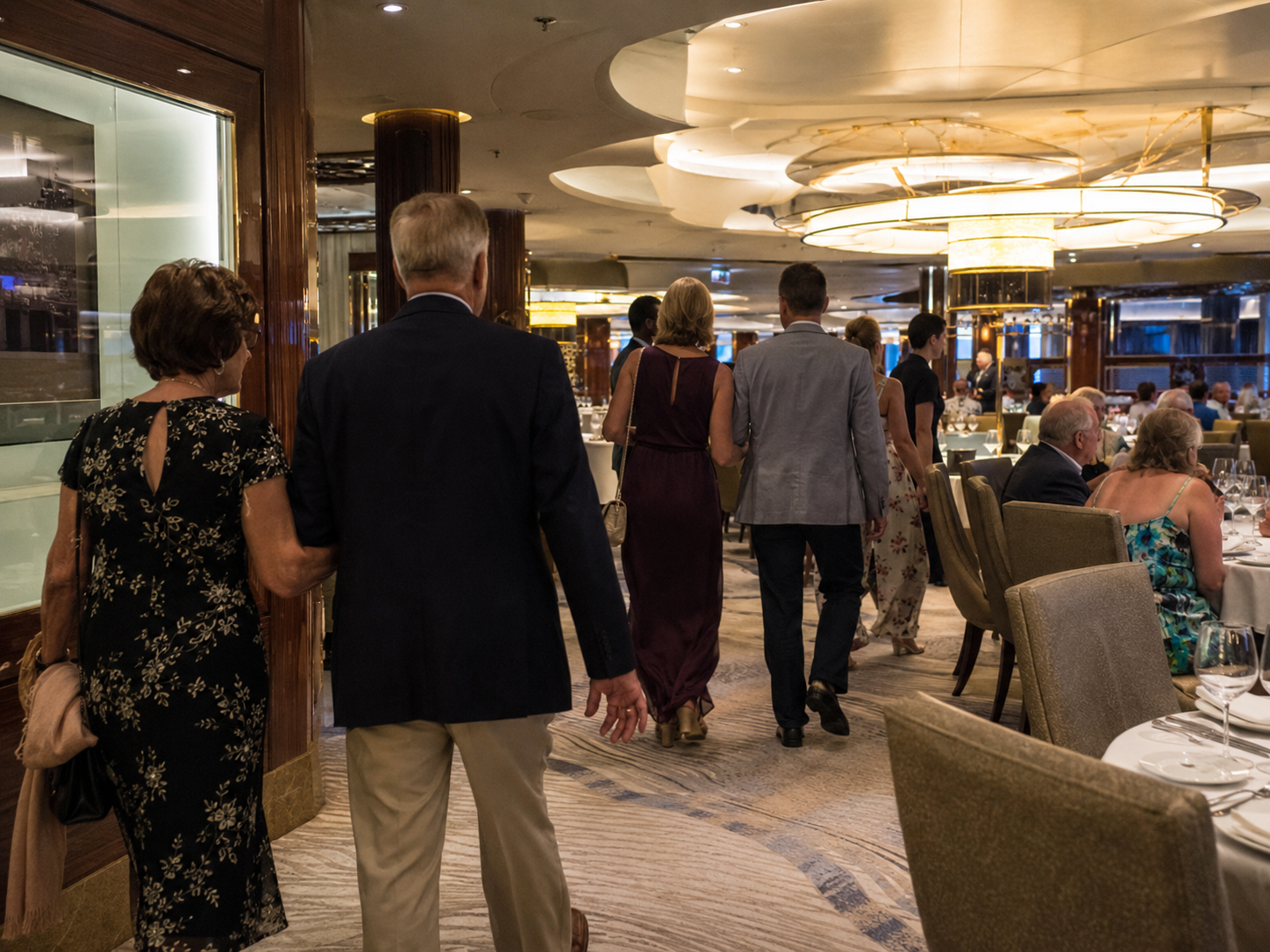
There are really only three dress codes, and you already own clothes for all of them. Daytime and the buffet are come-as-you-are. Dinner in the main dining room is "smart casual" most nights — a collared shirt or a sundress. And on the one or two "formal" nights a week, you step it up to a cocktail dress or a jacket. That's the whole system.
The reassuring part, because it trips up nearly every first-timer: dressing up is optional. Formal night is a suggestion, loosely enforced, and the casual venues stay open if you'd rather skip it. This guide, part of our New to Cruising guide, decodes the three codes, shows what each cruise line calls and enforces, and tells you exactly what to pack.
The three dress codes, decoded
Every cruise line uses its own branded names — Cruise Elegant, Evening Chic, Dress to Impress, Gala — but underneath the marketing there are only three real levels. Learn these and you can translate any line's lingo on sight. The codes apply to the main dining room and the theater in the evening; by the pool and at the buffet, anything goes, always.
Daytime & the buffet
1. Casual
- Shorts, t-shirts, sundresses, swimwear with a cover-up.
- The default for the whole ship during the day and at the buffet every evening.
- No thought required — wear what's comfortable.
Most dinners in the dining room
2. Smart casual
- Men: collared shirt (polo or button-down), slacks or clean jeans, closed-toe shoes.
- Women: a sundress, or a skirt/slacks with a nice top.
- What you'd wear to a relaxed restaurant on land. This is most nights.
1–2 nights a week
3. Formal / elegant
- Men: a suit, or a sport coat and slacks (tie optional).
- Women: a cocktail dress, dressy jumpsuit, or elegant separates.
- Tuxedos and gowns appear but are never required — "nice dinner out," not "red carpet."
Notice what's not on that ladder: nothing demands you buy anything. Smart casual is your everyday nice clothes; formal is one dressier outfit you probably already own. If you're packing for the whole trip, our cruise packing list folds all three codes into a single carry-on-friendly plan.
What each cruise line actually calls it
This is where the confusion lives — every line brands the same three codes differently and enforces them with different energy. Here's the honest, line-by-line translation for a typical week-long sailing, including how seriously each one takes it. This is the table we wish we'd had before our first cruise.
| Cruise line | What it calls the dressy night | Dressy nights (typical 7-night) | Everyday evening vibe | How strict |
|---|---|---|---|---|
| Royal Caribbean | "Formal" / Dress Your Best night | 1–2 | Casual & smart casual | Relaxed |
| Carnival | "Cruise Elegant" | 1–2 | Cruise Casual | Relaxed |
| Norwegian (NCL) | Optional "Dress Up or Not" night | 0 (none required) | Freestyle / casual | Most relaxed |
| Celebrity | "Evening Chic" | 1–2 | Smart casual | Moderate |
| Princess | "Formal" / Dress to Impress | 1–2 | Smart casual | Moderate |
| MSC | "Elegant" night | 1–2 | Informal / smart casual | Stricter |
| Disney | Optional "Dress-Up" night (+ Pirate Night) | 1–2 | Cruise casual | Relaxed |
| Holland America | "Gala" night | 2 | Smart casual | Stricter |
| Luxury lines (Cunard, Regent, Seabourn…) | "Formal" / Gala (Cunard is the dressiest afloat) | 0–1 (varies sharply) | Elegant casual | Strictest |
Counts are typical for a 7-night sailing — shorter cruises usually have one dressy night, longer ones more. Exact themes vary by ship and itinerary; your daily program confirms which nights are which.
The headline: on the big mainstream lines (Royal, Carnival, Disney) the dress code is gentle and rarely policed. Norwegian skips required formal nights entirely under its Freestyle model. Step up to Celebrity, Princess, and especially MSC, Holland America, and the luxury lines, and the dressy nights become more of a genuine occasion — Cunard's transatlantic crossings are the one place a tuxedo actually feels at home. If you're still deciding who to sail with, our guide to choosing a cruise line covers how their whole personalities differ, dress code included.
How many formal nights to expect
The number of dressy evenings scales with the length of your cruise, not the line you pick. As a rough rule that holds across most mainstream lines:
| Cruise length | Dressy / formal nights | What that means for packing |
|---|---|---|
| 2–4 nights | Usually 1 (sometimes 0) | One dressier outfit, or none if you'll dine casual that night. |
| 5–7 nights | 1–2 | One dressy outfit covers it; two if you like variety. |
| 8–14 nights | 2–3 | Two dressy outfits, re-worn with different accessories. |
| 15+ nights / luxury | 3 or more | More gala nights; check the line's specifics before packing. |
The dressy nights are almost always scheduled on sea days, never on a busy port day when you'd be rushing back to the ship to change. The first one usually lands on the second evening of the cruise. Your daily program — the next-day schedule left in your cabin each night — will name them, so you're never caught out. (New to that lingo? The cruise glossary decodes the rest.)
What to actually pack
Here's the part that saves you from over-packing a suitcase of clothes you'll never wear. You're dressing for two things: a stack of casual-to-smart-casual evenings, plus one or two dressier nights. That's it.
The whole week, packed light
For men
- Smart-casual nights: a few collared shirts (polos or button-downs) and a pair or two of slacks or dark jeans.
- Formal night: one sport coat or suit jacket with slacks. A tie is optional; a dark suit is the easy all-purpose answer.
- One pair of closed-toe dress shoes covers every dining-room evening.
- Skip the tuxedo unless you're on Cunard or simply enjoy it — nobody will miss it.
The whole week, packed light
For women
- Smart-casual nights: sundresses, or skirts and slacks with a few nice tops, mixed and matched.
- Formal night: one cocktail dress or dressy jumpsuit — add a wrap or light jacket for the air conditioning.
- One dressy outfit re-worn with different jewelry or a shawl easily handles two formal nights.
- A single pair of dressier flats or low heels does the job; comfort wins on a moving ship.
Pack one outfit you'd wear to a nice dinner back home, and you're covered for every formal night of the cruise. Everything else is just your normal casual and smart-casual clothes. The first-timers who stress over dress codes almost always over-prepare — you need one dressy outfit, not a wardrobe.
What you can't wear in the dining room
Even on a relaxed cruise-casual night, the main dining room and specialty restaurants draw a line at a handful of items in the evening. None of this applies to the buffet or the pool deck — it's specifically the served, sit-down venues after dark.
- Swimwear and pool cover-ups
- Tank tops, muscle shirts, and sleeveless tops on men
- Flip-flops and pool slides
- Baseball caps, visors, and hats
- Gym or athletic shorts, and ripped or torn jeans
- Bathrobes (yes, it has to be said)
The fix is trivial: long pants or a skirt and a shirt with sleeves clears the bar on every line, every night. Save the shorts and flip-flops for everywhere else on the ship, where they're completely fine.
How strict is it, really?
For most first-timers this is the actual question, so let's be straight about it. On the mainstream lines, the dress code is enforced gently — a host might politely redirect someone in swim trunks on formal night toward the buffet, but you won't be fined, removed, or embarrassed. The stricter lines (MSC, Holland America, Cunard) take it more seriously, and on those you'll feel out of place rather than punished if you under-dress. The strict exception is the luxury sector (like Seabourn or Cunard), where the main dining room enforces a hard door policy and will turn away guests who do not meet the jacket requirement.
The key thing to internalize: there's always an exit. Every formal night, the buffet and casual venues stay open and stay casual — that's by design, precisely so guests who don't want to dress up have somewhere to eat. Skipping formal night is a completely normal, common choice, not a faux pas. The same flexibility runs through dining generally; if you're weighing where to eat each night, our main dining room vs buffet breakdown pairs naturally with this one, and the dressier specialty restaurants tend to enforce smart-casual a touch more firmly than the main dining room does.
"Our honest take: the dress code is the single most over-worried-about part of a first cruise, and it deserves about a tenth of the anxiety it gets. Don't buy a tuxedo. Don't buy a gown. Bring one outfit you already feel good in, dress casually the rest of the week, and remember that on any night the whole thing feels like too much, dinner at the buffet is a perfectly respectable plan B."
Putting it together
Three codes, one or two dressy nights a week, and an open buffet for anyone who'd rather opt out — that's the entire cruise dress code in a sentence. Pack your normal nice clothes plus a single dressier outfit and you've solved it. From here, the natural next steps are building out the rest of your bag with our cruise packing list, sorting out what you'll wear getting aboard on day one with our embarkation day outfit guide, and decoding any other unfamiliar term in the cruise glossary — including the captain's cocktail party, the one event where a few guests do go all out.
Frequently asked questions
Do you have to dress up on a cruise?
No — dressing up is always optional. Every mainstream cruise line schedules one or two dressier evenings per week (called formal, elegant, chic, or gala night), but participating is entirely your choice. If you would rather not dress up, the buffet and the casual venues stay come-as-you-are every single night, so you can skip formal night completely and still eat well. Most nights aboard are simply "cruise casual" anyway — a collared shirt or a sundress is plenty. The one outfit worth packing is something you would already wear to a nice dinner back home; beyond that, no cruise requires you to buy anything special.
What does smart casual mean on a cruise?
Smart casual — also called cruise casual or resort casual — is the standard evening dress code in the main dining room on most nights. For men it means a collared shirt (polo or button-down) with slacks or clean, un-ripped jeans and closed-toe shoes. For women it means a sundress, a skirt or slacks with a nice top, or a casual dress. It is essentially what you would wear to a relaxed restaurant on land. What it rules out in the dining room is swimwear, tank tops, gym shorts, baseball caps, and flip-flops — those are fine by the pool and at the buffet, just not at the served dinner.
What should a man wear on a cruise formal night?
On formal or elegant night, the safe and common choice for men is a dark suit, or a sport coat and slacks, with or without a tie. A dress shirt with slacks and a blazer also passes comfortably on every mainstream line. Tuxedos do appear — and they are welcome — but they are the exception, not the rule, except on the most traditional luxury lines like Cunard. You do not need to buy or rent a tuxedo to enjoy formal night; a jacket you already own will fit right in, and if you would rather skip it entirely, the casual venues are open as usual.
What should a woman wear on formal night?
A cocktail dress is the most common choice, but a dressy jumpsuit, a skirt or dressy slacks with an elegant top, or a nice dress you already own all work beautifully. Full-length evening gowns appear, especially on luxury lines, but they are optional — most women aim for "nice dinner out" rather than "red carpet." One versatile dress plus a wrap or light jacket covers every formal night of a typical cruise, and you can dress it up or down with different accessories if there are two.
Can you wear shorts to dinner on a cruise?
Shorts are perfectly fine at the buffet, the poolside grill, and the casual cafes at any meal, including dinner. In the main dining room, however, most lines ask you to leave the shorts, swimwear, tank tops, flip-flops, and baseball caps behind in the evening — even on a regular cruise-casual night. The rule is loosely enforced and varies by line (Norwegian is the most relaxed, MSC and the luxury lines the strictest), but the simple workaround is to wear long pants or a skirt to the dining room and save the shorts for everywhere else.
What happens if you don't dress up on formal night?
Practically nothing. Formal night is a suggestion, not a rule with teeth. If you show up to the main dining room badly underdressed on a formal evening, a host may quietly point you toward the buffet, but you will not be fined, removed from the ship, or made a scene of (though true luxury lines will strictly turn you away at the dining room door). The far more common path is to simply eat at the buffet or a casual venue that night — they stay open and casual on formal nights specifically so guests who do not want to dress up have somewhere to go. Plenty of seasoned cruisers treat formal night as a fun photo opportunity and others skip it entirely; both are completely normal.