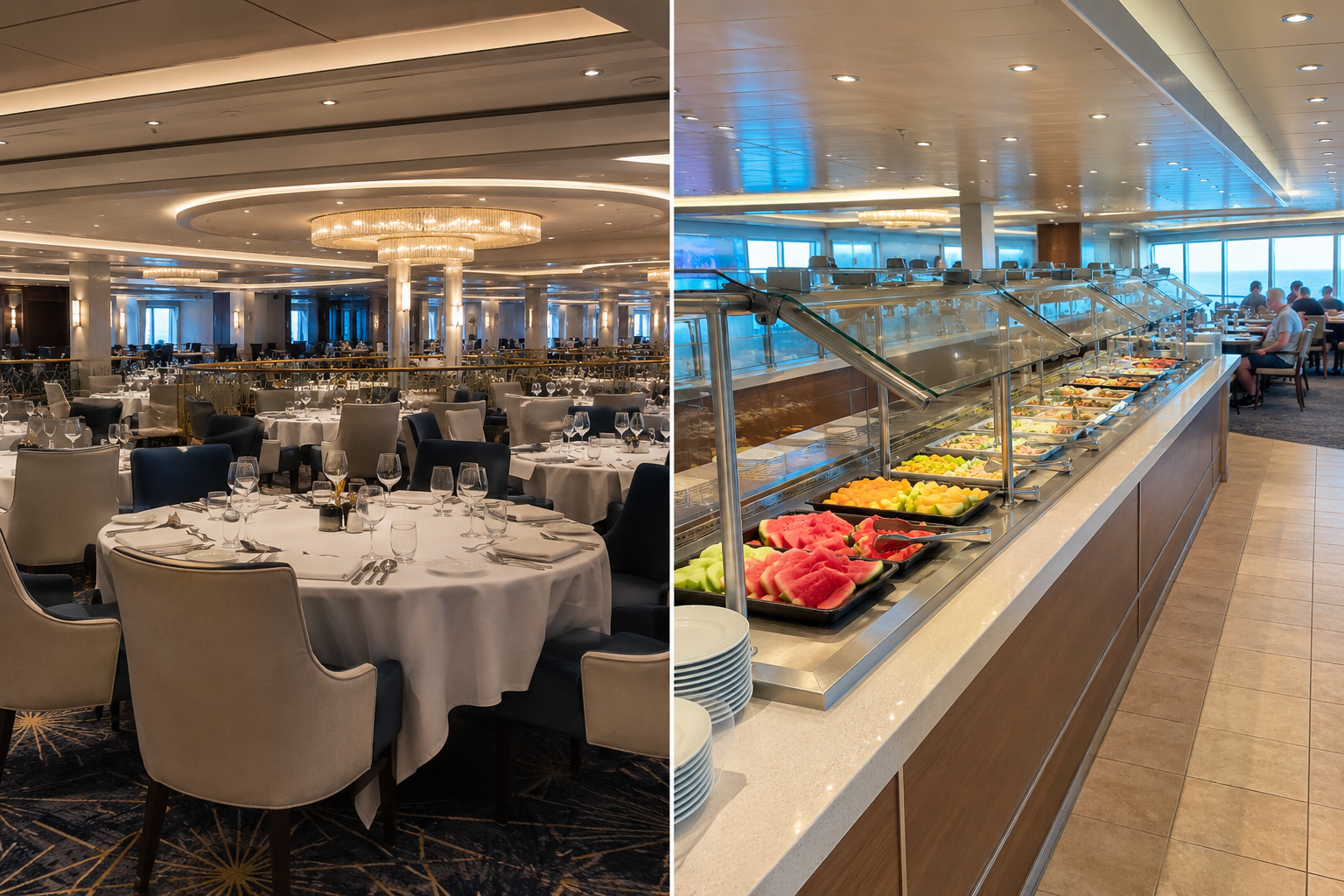
Don't choose one — use both, by meal. The buffet is the fast, flexible, come-as-you-are utility for breakfast and lunch and for any night you're wiped out. The main dining room (MDR) is the slower, served, slightly dressier event you'll want most evenings. Almost every seasoned cruiser settles into exactly that rhythm.
The one thing worth getting straight first, because it changes everything: neither costs extra. Both are included in your fare. This guide, part of our New to Cruising guide, walks through what each venue actually is, then breaks the decision down meal by meal so you can pick on instinct by day two.
First, kill the myth: the dining room is not an upcharge
The single most common — and most expensive — first-timer mistake is assuming the main dining room is some kind of premium upgrade and quietly defaulting to the buffet all week. It isn't. On every mainstream line, the MDR is included in your cruise fare exactly like the buffet: no cover charge, no per-meal fee, no catch.
What's free: the main dining room and the buffet, plus the poolside grill, the casual cafe, and room service on most lines (sometimes a small delivery fee). You can eat every meal of your cruise without spending another cent.
What actually costs extra: the specialty restaurants — the steakhouse, the Italian or sushi spot, the chef's table. Those carry a cover charge or à la carte pricing, and they're the only dining the "is it worth paying for?" question applies to. We dig into that in is specialty dining worth it.
So as you read the rest of this, drop the price tag from your thinking entirely. You're not choosing the cheaper option; you're choosing the one that fits the meal in front of you.
What each one actually is
They solve different problems. Knowing the personality of each makes the per-meal call almost automatic.
The served, sit-down evening
The main dining room
- Table service with a waiter and assistant who'll learn your name and your coffee order by night two.
- A rotating multi-course menu — appetizer, main, dessert — that changes every night, with daily specials you won't see at the buffet.
- A calmer, dressier room (white tablecloths, a real atmosphere) that turns dinner into the social anchor of the day.
- Order two appetizers, swap a side, try a dish and send it back for another — it's all included.
- The trade-off: it takes roughly 1.5 to 2 hours, and dinner runs on a seating system.
The fast, self-serve free-for-all
The buffet (Lido, Windjammer & friends)
- Self-serve stations — carving, salads, pasta, an omelet line at breakfast, a wall of desserts — where you build your own plate.
- Come and go as you please. No reservation, no seating time, no waiting between courses; in and out in twenty minutes if you want.
- Always casual. Shorts, swimsuit cover-ups, and flip-flops are fine at every meal, every night.
- See before you commit — a huge help for picky eaters and kids, who can graze across a dozen options.
- The trade-off: it can get busy and loud at peak times, and the dinner spread is smaller than midday.
The real decision is per meal, not per cruise
This is the part that makes it click. The right venue flips depending on which meal it is and what kind of day you're having. Here's how the choice tends to break down — and our honest pick for each.
| Meal | Main dining room | Buffet | Our pick |
|---|---|---|---|
| Breakfast | Sit-down, cooked-to-order eggs and a calmer start; often open on sea days only and a little slower. | Fast and vast; the obvious choice when you're racing to make a port or an excursion. | Buffet on port days MDR on a lazy sea day |
| Lunch | Usually open on sea days only; a pleasant, unhurried sit-down change of pace, sometimes themed. | Open every day, quickest option, best for grazing between pool and activities. | Buffet either on sea days |
| Dinner | The main event: multi-course, served, social, the rotating menu, a reason to clean up a bit. | Low-key and quick; quietly excellent when you're tired, casual, or wrangling kids. | MDR most nights Buffet when you're wiped |
| Late night & dessert | Closes after the dinner seatings wrap; not an option late. | Often the only game in town for a late bite, plus the dessert spread is hard to beat. | Buffet |
Exact hours and which venues open on which days vary by line and ship — check the daily program delivered to your cabin each evening.
How dinner seating works (the one MDR wrinkle)
The buffet has no system — you just walk in. The dining room does, and it's worth understanding before you book, because you usually pick when you reserve the cruise. There are two models:
- Traditional (fixed) seating — you're assigned a set time, typically an early seating around 5:30–6:00 p.m. or a late seating around 8:00–8:30 p.m., with the same table and the same waitstaff every night. Great if you like routine and want your servers to get to know you.
- Flexible dining — sold under names like Anytime, My Time, or open seating, it lets you show up whenever you like within dinner hours (roughly 5:30–9:30 p.m.). The freedom costs you a little: you may wait briefly at peak times and won't always get the same table or server.
Neither is better in the abstract — fixed seating suits people who like the rhythm and the relationship with their team; flexible suits people whose days (and port returns) run on no fixed schedule. And on any night the seating doesn't suit you, the buffet is always there, no booking required.
Who should lean which way
Most people end up doing both, but if your week skews toward one type of day, here's where to point yourself.
Make the dining room your default if…
Lean main dining room
- You see dinner as part of the vacation, not just fuel, and enjoy a longer, served meal.
- You're celebrating, on a couples' trip, or simply like the idea of a proper sit-down evening.
- You want variety you don't have to hunt for — the kitchen brings a new menu to you each night.
- You'd enjoy the same friendly team looking after you all week.
Make the buffet your default if…
Lean buffet
- You're traveling with young kids or picky eaters who do better seeing the food and leaving when they're done.
- Your days are packed with ports and activities and you want meals fast and flexible.
- You'd rather graze a bit of everything than commit to courses.
- You have no interest in dressing up or watching the clock for a seating time.
Stop thinking of it as a one-time choice. Buffet for breakfast and lunch, dining room for dinner is the default that works for most first-timers — then swap a buffet dinner in on any night you're too tired, too casual, or too busy for a long meal. You've already paid for both; the only mistake is using just one.
"Our honest take: the people who come home saying the cruise food was 'just okay' are almost always the ones who ate every meal at the buffet because they thought the dining room cost extra. It doesn't. Give the MDR your dinners, keep the buffet for everything fast, and you get the best of both — for the exact same price you already paid."
Putting it together
The whole debate dissolves once you realize you're not picking a side for the week — you're picking a venue for the next meal, and both are already yours. Default to the buffet when speed and flexibility matter and to the dining room when the meal itself is the point. If you're still mapping out what your fare does and doesn't cover, our guide to what's actually included on a cruise lays it all out, and if you want to sidestep the rookie slip-ups, the first-time cruise mistakes to avoid leads with this exact one. Curious whether the paid restaurants earn their cover charge? That's is specialty dining worth it. And any unfamiliar menu or venue term is decoded in the cruise glossary.
Frequently asked questions
Does the main dining room cost extra on a cruise?
No. On every mainstream cruise line, the main dining room (MDR) is included in your cruise fare exactly like the buffet — there is no cover charge and no per-meal fee for either one. The only restaurants that cost extra are the specialty restaurants (the steakhouse, the Italian or sushi venue, the chef's table), which carry a separate cover charge or à la carte pricing. Many first-timers skip the dining room because they assume it is an upgrade; it is not, and doing so means leaving a multi-course meal you have already paid for on the table.
What is the difference between the main dining room and the buffet?
The main dining room is a sit-down restaurant with table service, a rotating multi-course menu that changes nightly, white tablecloths, and a calmer pace — it is the evening event of the day. The buffet is a large, casual, self-serve venue where you build your own plate from many stations and come and go as you please, with no reservations and no waiting for courses. Both serve good food and both are free; the difference is service and pace, not quality. The buffet wins on speed and flexibility, the dining room on experience and atmosphere.
Is the buffet open for dinner too?
Yes. The buffet is typically open for breakfast, lunch, and dinner, though the dinner spread is usually smaller than at midday and some stations close earlier in the evening. It is a perfectly good dinner option when you are tired after a port day, when you are dining with restless kids, or when you simply do not feel like a long sit-down meal. You will not be underdressed, you will not need a reservation, and you can be in and out in twenty minutes.
Do I have to dress up for the main dining room?
Most nights the main dining room is simply cruise casual — a collared shirt or a sundress is plenty; no jacket or gown required. Lines schedule one or two dressier evenings per week (often called elegant, formal, or chic night) when guests are asked to step it up, but even then the bar is modest and not enforced harshly. If you would rather not dress up at all on those nights, the buffet stays fully casual every night of the cruise, which is one of the most common reasons people choose it. For the full breakdown of what each night calls for, see our cruise dress code guide.
How does dinner seating work in the main dining room?
You usually choose between two systems when you book. Traditional (fixed) seating assigns you a set time — an early seating around 5:30 to 6:00 p.m. or a late seating around 8:00 to 8:30 p.m. — plus the same table and the same waitstaff every night, which is great for building a rapport with your servers. Flexible dining, branded names like Anytime, My Time, or open seating, lets you show up whenever you like within dinner hours (roughly 5:30 to 9:30 p.m.), though you may wait briefly at peak times and you will not always get the same table or server. The buffet, by contrast, has no seating system at all — you just walk in.
Which is better for picky eaters or kids?
For young children and picky eaters, the buffet is usually the lower-stress choice: everyone sees the food before committing, there is no waiting between courses, plates can be refilled instantly, and you can leave the moment a toddler melts down. The main dining room still works well for families — there is almost always a kids' menu with familiar favorites, and the waitstaff are patient — but it asks everyone to sit through a longer, multi-course meal. A common rhythm is buffet dinners on busy or tiring days and the dining room when the table has the patience for it.