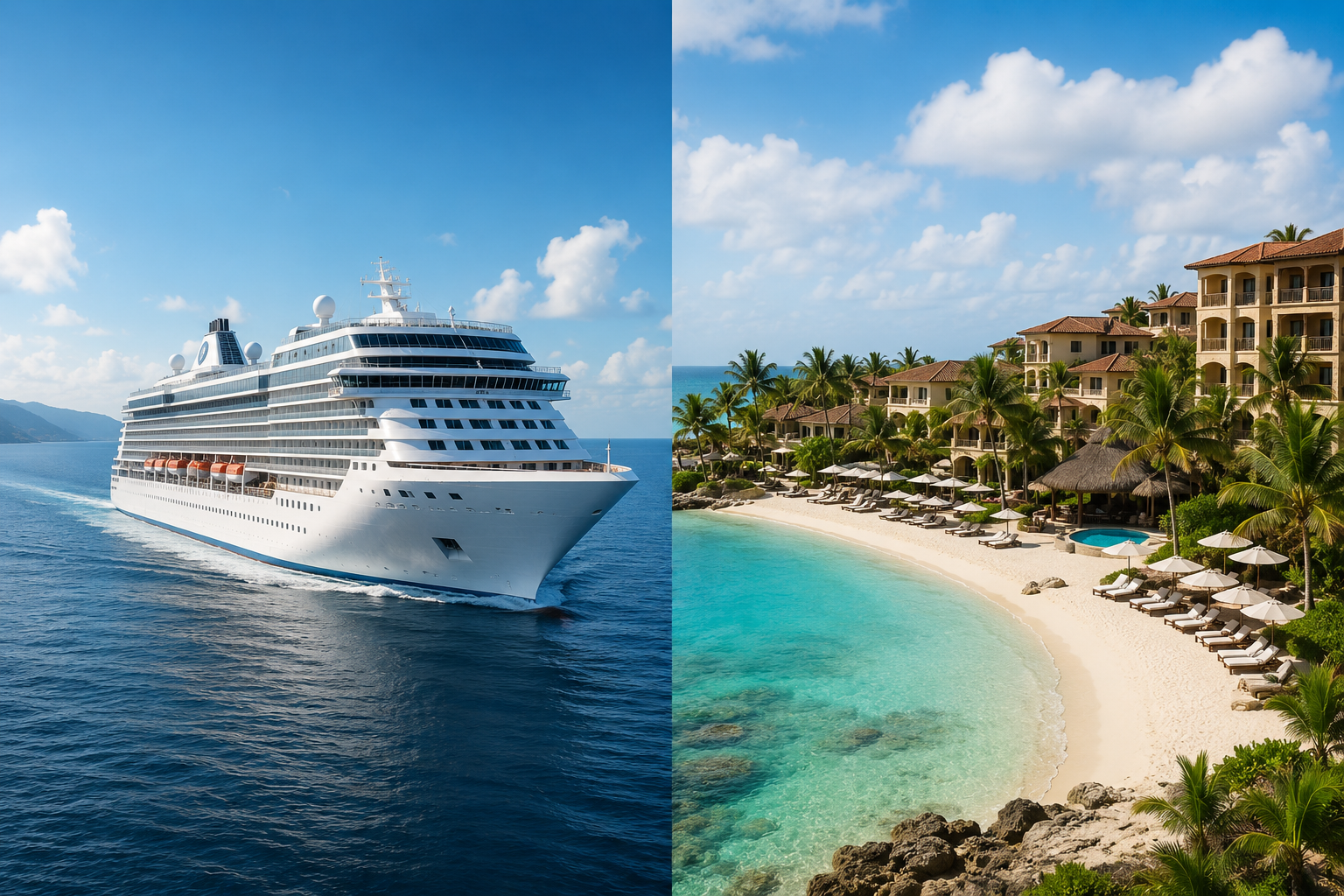
Neither vacation is cheaper across the board, and anyone who tells you otherwise is comparing the wrong numbers. The honest comparison turns on two things: how "included" each one really is, and whether you'd rather move or stay put. A resort genuinely bundles your food, drinks, and beach into one rate. A cruise advertises a low fare and recoups the difference once you're aboard — through drinks, Wi-Fi, gratuities, and excursions. Price the whole trip rather than the sticker and the two usually land closer than they look.
Once the money is close, the real tiebreaker is the experience: a cruise visits several destinations and packs in entertainment, while a resort lets you unpack once and never check a clock. This guide — part of our New to Cruising guide — breaks down what each one really includes, how to compare the true totals, and which suits how you travel.
The trap hiding in the word "all-inclusive"
The whole comparison gets distorted by one word. At a resort, all-inclusive is close to a promise: your room, every meal, unlimited drinks, the pool, the beach, and daytime activities are folded into the price you pay before you leave home. On a cruise, the same instinct — "it's a floating all-inclusive" — is mostly a myth on the big mainstream lines. A cruise fare covers your cabin, most meals in the main dining room and buffet, and the bulk of the entertainment. Almost everything else — alcohol, soft drinks, specialty restaurants, Wi-Fi, gratuities, the spa, and shore excursions — is extra. (A handful of luxury lines run a true all-inclusive cruise, with drinks and tips built in, but they're the exception.)
That single difference drives everything else. The cruise line deliberately sets a low base fare to win the booking, then earns its margin from what you buy once you're a captive audience at sea. The resort sets a higher sticker but has far less left to sell you. So the cruise looks like the runaway bargain on the booking page and often isn't by the time you sail home. Understanding exactly what's included on a cruise is the key that makes this whole comparison fair.
Cruise vs resort, side by side
Here's an honest, line-by-line read on where the two formats actually differ — not the brochure version. Green marks what's genuinely bundled in; coral marks what tends to land on your bill as an extra.
| What you're comparing | On a cruise | At an all-inclusive resort |
|---|---|---|
| Headline price | Lower sticker — priced to win the booking | Higher sticker — but closer to the real total |
| What the base rate covers | Cabin, most meals, core entertainment | Room, all meals, all drinks, pool, beach, daytime activities |
| Alcohol & soft drinks | Extra — per drink, or a daily package plus ~18–20% gratuity | Included — premium brands sometimes cost more |
| Dining | Main dining & buffet free; specialty restaurants extra | Buffet & à la carte included; top restaurants sometimes extra |
| Gratuities | Daily auto-gratuity added per person | Usually built in — staff still appreciate cash tips |
| Activities & entertainment | Big — shows, waterslides, clubs, nightlife | Pool, beach, some shows — smaller in scale |
| Scenery | Changes daily — multiple ports, even countries | One beach and one view all week |
| Off-property tours | Shore excursions extra in each port | Off-resort excursions extra |
| Budget predictability | Hardest — the extras quietly add up | Easiest — most spending is prepaid |
An independent read, framed evergreen — specific inclusions vary by cruise line, resort brand, and room or cabin tier, so always confirm the fine print on the exact trip.
The real cost: price the whole trip, not the sticker
Compare the two advertised fares and the cruise wins easily. Compare what you'll actually spend, and it's a real contest. On a cruise, the predictable add-ons — a drink or beverage package, Wi-Fi, daily gratuities, a couple of specialty dinners, and a tour in each port — routinely pile 30 to 50 percent on top of the base fare. That's not a worst case; it's the normal experience for a couple who drinks a little, wants to stay connected, and gets off the ship to see the places they sailed to. Our guide to what a cruise actually costs walks through the math, and how to save money on a cruise covers the levers that keep those extras down.
The resort plays the opposite game. Its higher sticker already absorbs the food and drink that quietly inflate a cruise bill, so the final number drifts up far less. But "all-inclusive" has fine print of its own: resort fees and taxes, premium liquor, the best specialty restaurants, motorized water sports, spa treatments, airport transfers, any tour that leaves the property, and the cash tipping that staff still expect even where gratuities are "included." None of those are cruise-sized surprises, but together they keep the resort from being quite as all-in as the brochure suggests.
The takeaway is the same for both: load each price up with the extras you'll genuinely buy, then compare the totals. Do that honestly and a mainstream cruise and a mid-range resort usually land within striking distance of each other — close enough that price alone shouldn't make the decision.
Beyond money: how the two weeks actually feel
When the totals are close, the choice is really about the shape of the vacation. The single biggest difference is motion. A cruise moves: you can wake up in a different port most mornings, sample several destinations in one week, and never repack — and if weather turns bad, the ship can simply sail around it. A resort stays put: one beach, one pool, one rhythm, with nothing to plan and no schedule to keep. Whether that sounds like freedom or monotony tells you most of what you need to know.
The rest follows from there. Cruises tend to win for school-age kids, teens, and multigenerational groups who all want different things at once — the sheer volume of activity, entertainment, and dining keeps everyone busy. Resorts often suit young families and couples chasing pure relaxation, where a slow, stay-in-one-place pace is the entire point. For variety, energy, and seeing more of the world in a week, the cruise delivers; for unhurried, predictable, do-nothing rest, the resort does. Neither is "better" — they're built for different appetites. (Still deciding whether to cruise at all? Our take on whether a cruise is worth it tackles that question head-on.)
Compare fully loaded totals first, then let the experience break the tie. Add every extra you'll actually buy to each price — drinks, tips, Wi-Fi, the tours you'll take — and the two usually land within a few hundred dollars. When the money is that close, stop arguing about price and ask the only question that truly separates them: do you want to wake up somewhere new every morning, or in the same comfortable bed all week?
So which should you book?
With the cost roughly even, the decision comes down to how you most want to spend the week. Find yourself in one of these two columns.
Pick the cruise if…
You want your vacation to go somewhere
- You'd rather see several destinations than one, without repacking.
- You're traveling with teens or a multigenerational group who need constant variety.
- Big entertainment — shows, waterslides, nightlife — is part of the appeal.
- You like the idea of unpacking once and still moving each day.
- First time? Start with a shorter sailing to keep the stakes low.
Pick the resort if…
You want it to stay exactly where you left it
- Your ideal week is the same beach chair every day, no schedule.
- Totally predictable budgeting matters more than a low headline price.
- Unlimited drinks already baked in is a major draw.
- You're traveling with young kids who want a slow pace and a pool.
- You're a nervous first-timer who'd rather skip ship logistics entirely.
"Our honest take: 'all-inclusive' is a marketing word on a cruise and a near-promise at a resort — but that doesn't make the resort cheaper. It makes it simpler. Pay for the cruise if you want your vacation to go somewhere; pay for the resort if you want it to stay exactly where you left it."
If the cruise side won you over, the natural next steps are figuring out what's actually included, pinning down the real cost, and choosing your line with our guide to the best cruises for first-timers. The cruise glossary explains any term here in plain English. And if you drink more than a little, the choice between a cruise's drink package and a resort's bottomless bar can tip the whole comparison on its own.
Frequently asked questions
Is a cruise or an all-inclusive resort cheaper?
It depends entirely on how you compare them. A cruise almost always shows a lower headline fare, because cruise lines price the base ticket to win the booking and expect to recoup the rest from onboard spending — drinks, Wi-Fi, gratuities, specialty dining, and shore excursions can add roughly 30 to 50 percent on top of the fare. An all-inclusive resort shows a higher sticker but bundles most of that spending in, so the final bill moves less. Once you add the extras you'll actually buy to each one, a mainstream cruise and a mid-range resort usually land surprisingly close. The only fair comparison is the fully loaded total, not the advertised starting rate.
Are cruises really all-inclusive?
Not in the way the phrase usually means. A cruise fare covers your cabin, most meals in the main dining room and buffet, and the bulk of the onboard entertainment — but alcohol, soft drinks, specialty restaurants, Wi-Fi, gratuities, the spa, and shore excursions are nearly all extra. A small number of luxury cruise lines are genuinely all-inclusive, with drinks and tips built in, but the big mainstream lines are not. That's the core difference from a resort, where unlimited food and drink are normally part of the one rate you pay up front. (Here's the full breakdown of what's included on a cruise.)
What does an all-inclusive resort include that a cruise doesn't?
The headline difference is drinks: unlimited alcoholic and soft drinks are almost always part of an all-inclusive resort rate, while on most cruises you pay per drink or buy a beverage package with an automatic gratuity on top. Resorts also typically fold all meals (buffet and à la carte), pool and beach access, daytime activities, non-motorized water sports, and gratuities into one price. On a cruise those are unbundled to varying degrees. The catch is that resorts still charge extra for premium liquor, the best specialty restaurants, motorized water sports, spa treatments, and any tour that leaves the property — so "all-inclusive" has fine print on both sides.
Is a cruise or all-inclusive resort better for families?
Both work well; the right pick tracks your kids' ages and energy. Cruises tend to win for school-age kids and teens, who thrive on the constant variety — waterslides, shows, kids' and teen clubs, new ports — and for multigenerational groups who want everyone entertained at once. All-inclusive resorts often suit young families better: a single pool and beach, a slower pace, no daily schedule to keep, and no ship logistics to manage. If your family gets restless staying in one spot, lean cruise; if they relax best by unpacking once and settling in, lean resort.
Which is more relaxing, a cruise or an all-inclusive resort?
For pure, do-nothing relaxation, an all-inclusive resort usually edges it. You unpack once, never check a clock, and everything you need is within a short walk, with no all-aboard times or port days to plan around. A cruise can be deeply relaxing too — especially on sea days — but it rewards people who enjoy a bit of motion in their vacation: changing scenery, new destinations, a packed activity schedule if you want it. If your idea of a perfect week is the same beach chair every day, choose the resort; if it's waking up somewhere new, choose the cruise.
Is a cruise or a resort better for a first-time traveler?
An all-inclusive resort is often the simpler first trip: you fly in, check in, and there are no ship logistics, embarkation steps, or port schedules to learn. A cruise asks a little more of a first-timer up front, but it also removes a lot of decision-making once you're aboard and shows you several destinations in one go. If the idea of learning how a ship works feels like too much, start with a resort; if the appeal is variety and seeing more than one place, a cruise is worth the small learning curve — and starting with a good first-timer's line and a shorter sailing keeps the stakes low.