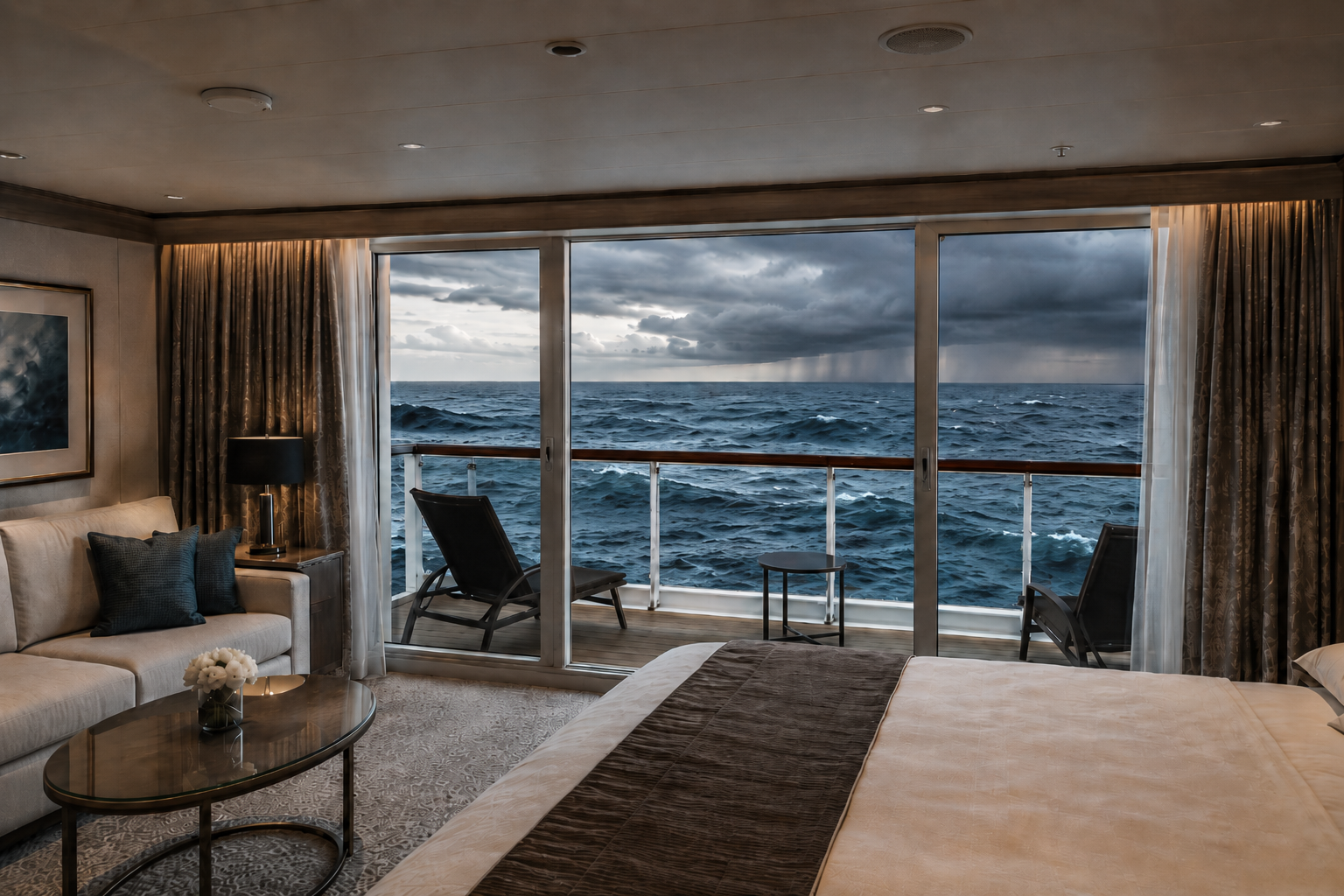
Book a cabin that is low in the ship and midship — the middle of the vessel, on one of the lower passenger decks. That's the spot that moves the least, because it sits right on the ship's pivot point and closest to its center of gravity. Add an oceanview or balcony if you can, so you have the horizon to look at, and avoid high decks and the far forward or aft ends, which swing and pitch the most.
The best part: a calmer cabin usually costs the same as — or less than — the high, dramatic ones first-timers gravitate toward. This guide, part of our New to Cruising guide, shows you exactly where to look and how to weigh it against the cabin you actually want.
Why some cabins barely move and others don't
A ship rocks around a central point, the way a seesaw tips around its middle. Two simple ideas explain almost everything about which cabins feel calm:
- Front-to-back: the middle is the pivot. A ship pitches (nose up, nose down) and rolls around its center. The closer you are to that midship pivot point, the smaller the arc you travel through. The bow and stern sit at the ends of the seesaw, so they rise and fall the most.
- Up-and-down: lower is steadier. Picture a metronome — the tip sweeps a wide path while the base barely moves. Higher decks are farther from the center of gravity, so the same roll throws them through a much bigger swing. Lower decks, nearer the waterline, stay closer to calm.
Put those together and the steadiest place on any ship is the same: low and central. Everything else on this page is just applying that one rule. (If the words bow, aft, and midship are new, our glossary entry on bow, aft, and midship explains the ship's orientation in plain English.)
The ship's calm zones, at a glance
If you sliced the ship down the side and shaded it by how much each area moves, it would look like this. The greener the zone, the steadier the ride.
The lesson is the diagonal: motion grows as you move toward the ends and as you move up. The worst seat in the house for a queasy stomach is a high cabin right at the bow or stern; the best is a low cabin dead center.
Reading it onto a real deck plan
Cruise-line websites let you pick your exact cabin on a deck plan, so you can apply the rule directly. Here's how each choice maps to the ride.
| Where it is | How it rideswhat you'll feel | Book it if…the trade-off |
|---|---|---|
| Low & midship | Calmest. Least pitch and roll of anywhere on the ship. | Seasickness is a real worry — this is the top pick, full stop. |
| Mid-deck midship | Still very steady, with easier access to pools, dining, and decks. | You want a calm ride but don't love being deep in the ship. |
| Low, forward or aft | The low deck helps, but the ends still pitch noticeably in swell. | A specific cabin or price tempts you and the seas will be calm. |
| High & midship | Central position helps, but height adds a slow, swaying roll. | You prioritize views and aren't very motion-sensitive. |
| High, forward or aft | Roughest. Maximum pitch and roll; the most motion-prone cabins aboard. | You never get seasick and want the dramatic forward or aft view. |
"Low," "mid," and "high" are relative to each ship — aim for a passenger deck in the lower third and a cabin near the middle of the ship's length.
Does the cabin type matter — balcony, oceanview, or inside?
Location beats type every time: a low, midship inside cabin will out-ride a high, forward suite. But once you've nailed the location, the type adds a second, smaller effect on how you perceive motion.
For most people, an oceanview or balcony helps, because seeing the horizon gives your eyes a fixed, level reference — and motion sickness is largely a quarrel between what your inner ear feels and what your eyes see. Fresh air on a balcony settles a lot of stomachs too. A windowless inside cabin is the wild card: a minority of travelers find it calming because there are no moving visual cues at all, but many find the opposite — feeling motion they can't see is worse, not better. If you're unsure, choose the window. The trade-offs between cabin types in general — space, light, and price, not just motion — are laid out in our inside vs balcony vs suite comparison.
When two cabins tempt you, ask: which one is lower and closer to the middle of the ship? That cabin wins for motion — every time. Height and a forward or aft view are luxuries you trade away the moment seasickness is a genuine concern.
The cabin is only part of it: ship and route
Choosing well inside the ship matters, but two bigger levers sit above it. Ship size changes the ride: a large, modern vessel with up-to-date stabilizers shrugs off swell that a small ship would roll through, so if motion frightens you, lean toward a big, stable ship. And the itinerary sets the seas you'll cross — a Caribbean loop or a coastal sailing is far gentler than an open-ocean crossing or a route known for rough water. Stack all three in your favor — big ship, calm route, low midship cabin — and you've done nearly everything booking can do before you board.
Match the cabin to how sensitive you are
How hard you should chase the calmest cabin depends on you. Find the column that sounds right.
Prone to motion sickness
Go all-in on location…
- Book as low and midship as the deck plan allows.
- Choose an oceanview or balcony for the horizon.
- Pick a large ship on a calm itinerary.
- Pack remedies as backup, just in case.
Rarely or never queasy
Choose freely…
- Book the cabin you actually want — view, deck, or location.
- A high or forward cabin is fine; you'll barely notice motion.
- Keep midship in mind only for long open-water stretches.
- Spend the savings on the experience, not the insurance.
"Our honest take: if seasickness genuinely worries you, treat cabin location as the first decision, not an afterthought. It's the rare cruise upgrade that costs nothing and works whether or not you ever take a pill."
What the right cabin can't do
A calm cabin stacks the odds heavily in your favor, but it can't promise a motion-free trip — rough weather moves the whole ship, low midship cabin and all. Think of location as the foundation and remedies as the backup: meclizine or its relatives, a scopolamine patch from your doctor, ginger, and acupressure bands all have their place. Our full guide on whether you'll get seasick on a cruise walks through which remedies actually work and what to do if you feel queasy once you're aboard. If a snug inside cabin is part of your plan and small spaces make you uneasy, our take on feeling closed-in in a cruise cabin is worth a look, and the related question of which deck to choose often gets settled at the same time as the seasickness question.
Still piecing the booking together? The cruise glossary decodes any deck-plan jargon that trips you up, and our broader cabin comparison guide covers everything beyond motion — space, budget, and which cabin suits your trip.
Frequently asked questions
What is the best cabin to avoid seasickness on a cruise?
Book a cabin that is low in the ship and midship — roughly the middle of the vessel, on one of the lower passenger decks. That spot sits closest to the ship's center of gravity and on its pivot point, so it sways and pitches the least. An oceanview or balcony there adds a second benefit: a clear view of the horizon, which gives your eyes a steady reference and settles the inner-ear conflict behind motion sickness. The single rule to remember is low and central.
Is a lower or higher deck better for seasickness?
Lower is steadier. The higher you go, the more you feel the ship's roll, because the upper decks sit farthest from the center of gravity and swing through the widest arc — like the top of a metronome moving more than its base. High decks are wonderful for views and quick access to the pool and buffet, but if motion is your main worry, trade some of that convenience for a lower deck closer to the waterline.
Do balcony cabins help with seasickness, or is an inside cabin better?
For most people a midship, lower-deck oceanview or balcony is the most reassuring choice, because seeing the horizon gives your eyes a fixed point that calms the inner-ear mismatch, and fresh air helps too. A windowless inside cabin works for some travelers by removing the moving visual cues entirely — but for many it does the opposite, since you can feel motion you can't see. If you're unsure, choose a window or balcony; the horizon is the more reliable fix. Either way, location in the ship matters far more than cabin type — see our cabin comparison guide for the full trade-offs.
Which cabins should I avoid if I get seasick?
Avoid cabins that are high up and at the far ends of the ship — the forward (front) and aft (back) sections, especially on the upper decks. The bow pitches up and down the most in head seas, the stern can vibrate and feel the wake, and high decks amplify the roll. A top-deck forward suite may have a spectacular view, but it is the most motion-prone cabin on the ship.
Does the ship matter as much as the cabin for seasickness?
Both matter, and they stack. A larger, modern ship with up-to-date stabilizers rides more smoothly than a small vessel, and a calm itinerary — Caribbean rather than open-ocean crossings or the Drake Passage — keeps the seas gentler. Pick a big stable ship on a sheltered route and then a low, midship cabin within it, and you have done almost everything booking can do to reduce motion before you even board.
Can the right cabin completely prevent seasickness?
No — cabin choice strongly reduces how much motion you feel, but it can't promise a motion-free trip, because rough weather moves the whole ship. Think of it as stacking the odds: a low, midship cabin on a large ship doing a calm itinerary handles the location side, and remedies like meclizine, a scopolamine patch, ginger, or acupressure bands handle the rest. Cabin first, remedies as backup — our seasickness guide covers the remedy side in detail.
This guide is general information for choosing a cabin, not medical advice. If motion sickness affects you severely or you have a health condition, talk to a doctor or pharmacist about remedies before you sail.