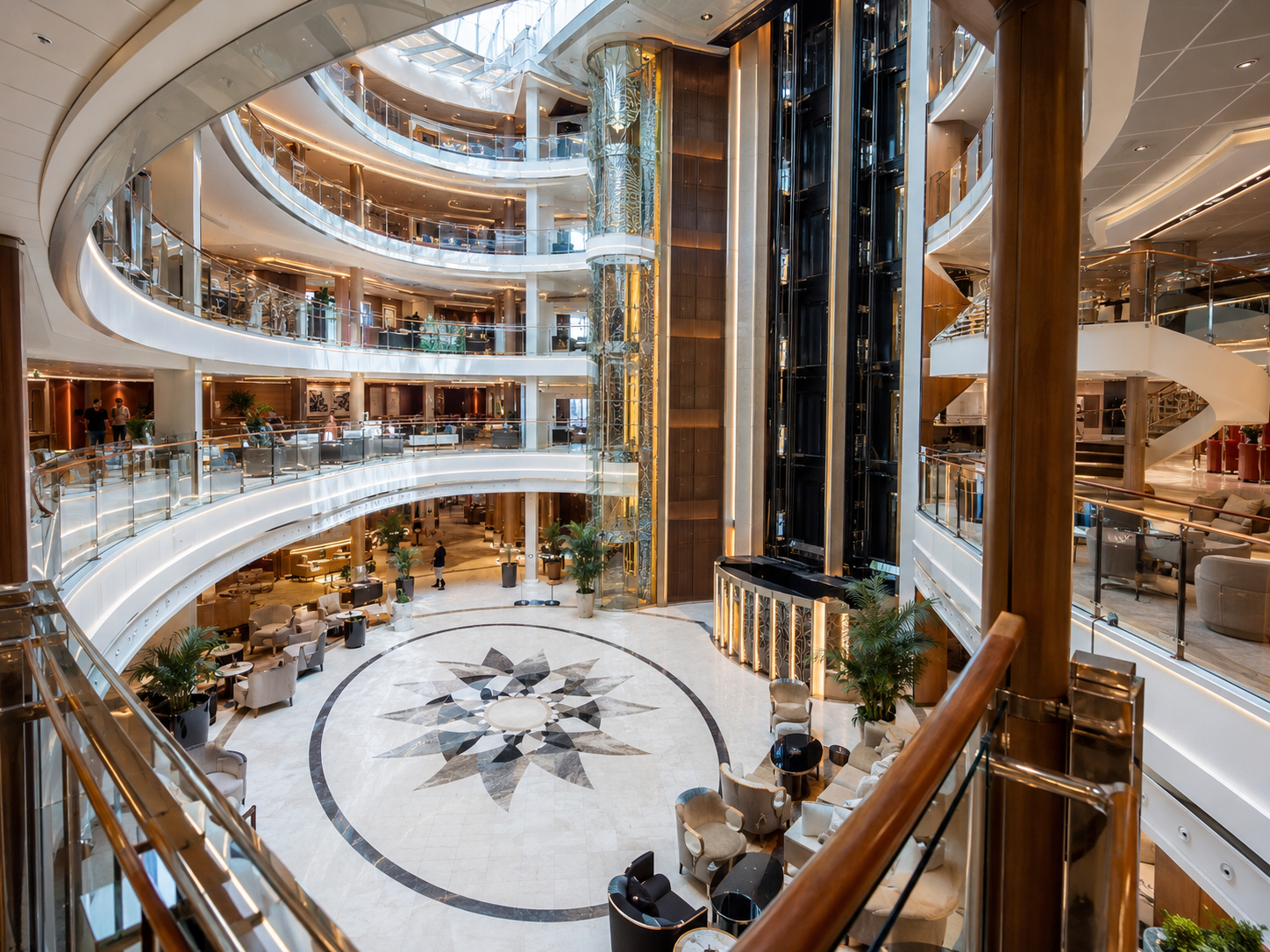
No — for most people, a cruise ship isn't considered a strong trigger for claustrophobia. Modern ships are built around openness: atriums that climb eight or more decks, indoor promenades the length of a city block, and open-air sun, pool, and sports decks where the only ceiling is the sky. You spend your waking hours in those big spaces.
The one place that can feel tight is a windowless interior cabin — and that's a booking decision, not a fact of cruising. This guide, part of our New to Cruising guide, walks through where the closed-in feeling actually comes from, which cabin removes it, and exactly what to do whether your worry is mild or real.
Why ships feel bigger, not smaller
The fear usually comes from imagining the wrong thing. People picture the cramped cabin of an old ferry, or a submarine, or being "trapped" with no way off. A modern cruise ship is the opposite of all three. Step aboard and the first reaction is almost always the same: this is enormous.
That impression is by design. The architecture of a big ship is built to fight any sense of confinement:
- The atrium. The social heart of most ships is a multi-story open void — frequently eight, ten, or more decks tall — ringed with balconies, glass elevators, bars, and shops. You can stand at the bottom and look straight up at daylight.
- Open-air decks. The top of the ship is acres of open deck: pools, loungers, walking and jogging tracks, sports courts, sometimes a park or a real lawn. Sky in every direction.
- Indoor promenades. Wide interior boulevards run much of the ship's length, lined with shops and cafés and topped by tall ceilings or skylights — they feel like a street, not a corridor.
- Windows everywhere. Dining rooms, lounges, the buffet, and the spa are typically wrapped in floor-to-ceiling glass looking out at the ocean.
The cabins are compact — more on that next — but you use a cabin the way you use a hotel room: to sleep, shower, and change. Your day happens in the wide-open rest of the ship, and you can walk out onto an open deck and see the horizon at any hour, day or night. That single fact is what reassures most nervous first-timers within an hour of boarding.
Where the closed-in feeling actually comes from
If a ship is so open, why does the worry persist? It nearly always traces to one specific room: the standard interior (inside) cabin — a stateroom with no window, roughly 150 to 185 square feet, about the size of a small, tidy hotel room. With the door closed and the lights off at night, a windowless room is the one spot on the ship that can feel like a box.
Here's the reassuring part: that's the only genuinely enclosed space you'll spend real time in, and it's the easiest thing in the world to design around. Cruise lines sell cabins on a ladder of openness, and where you book on that ladder decides whether claustrophobia is ever a factor at all. Cabin choice isn't a side detail here — it is the entire fix.
The openness ladder: pick your cabin, solve the problem
Think of cabin types not by price but by how open each one feels. From most enclosed to most open:
The virtual balcony deserves a special mention for anxious travelers. Pioneered by Royal Caribbean and found on a number of its ships, it fits a standard interior cabin with a floor-to-ceiling high-definition screen streaming a live outside view — horizon, daylight, and all. It costs more than a plain interior but less than a true oceanview, and you can mute it, curtain it, or switch it off. For a claustrophobic first-timer on a budget, it's often the sweet spot.
The cabin types at a glance
If you're weighing one cabin type against another with claustrophobia in mind, here's the quick read.
| Cabin type | Typical sizevaries by ship | How open it feels | Book it if… |
|---|---|---|---|
| Interior | ~150–185 sq ft, no window | Most enclosed. Fine by day; can feel like a box at night. | Your worry is minimal, you're on a tight budget, and you'll barely be in the room. |
| Virtual balcony | Interior size + a live screen | A windowless room that reads as open, thanks to a live outside view. | You want the open feel of a window for close to interior money. |
| Oceanview | ~170–190 sq ft, fixed window | Naturally light; a real horizon. Never feels sealed. | You want the worry gone without a balcony's price — the key upgrade. |
| Balcony | ~180–215 sq ft interior + open-air space | The most open of all — step outside any time. | Claustrophobia is a real fear, or you simply want the most reassuring room. |
Square footage is approximate and differs by cruise line and ship class; a balcony's figure usually includes the open-air space. Always check the specific deck plan before booking.
If claustrophobia is a real concern, never book a standard windowless interior. Spend the upgrade on a view to the outside — an oceanview window at minimum, a balcony if you can — and the worry is largely solved before you ever board. Everything else is a bonus; the window is the cure.
Match the plan to your worry
"Claustrophobic" covers everything from a mild dislike of small rooms to a genuine fear. Find the description that sounds like you.
A mild, manageable worry
If it's mild…
- An oceanview cabin (or a virtual-balcony interior) is plenty — a window does the work.
- Book midship and lower for the steadiest ride, so motion never compounds the unease.
- Keep cabin and bathroom doors open and a light on; treat the room as a place to sleep.
- Plan your days around the open decks and lounges — you'll forget the worry by lunch.
A real, "this could ruin it" fear
If it's serious…
- Book a balcony — open air and a horizon on demand is the single biggest reassurance.
- Choose a large, modern ship with big atriums and open spaces over a small vessel.
- Know your exits: open promenades and outdoor decks are reachable from anywhere in minutes.
- If a panic disorder is involved, talk to your doctor about coping tools before you sail.
Already booked in an interior? Don't panic
Plenty of people who worried beforehand sail happily in an inside cabin, because the room barely figures into the trip. If you're in this spot, a few simple habits make it a non-issue:
- Keep it from feeling sealed. Leave the bathroom and closet doors open and a light on, so the space reads as a room, not a box — especially at night.
- Use the cabin only for sleeping. Build your day around the open decks, the promenade, the lounges, and the dining rooms. You'll be in the room far less than you expect.
- Crack the door, briefly. Stepping into the bright, open corridor for a moment resets the feeling quickly if it creeps in.
- Ask about an upgrade. Call your cruise line or travel agent — paid moves to an oceanview or balcony are often available right up to sailing, and an upgrade to a window is the most reliable cure of all.
It's worth saying plainly: the "trapped" feeling some people fear — no way off, nowhere to go — doesn't match the experience. You're free to roam the entire ship around the clock, the open deck is always a short walk away, and on most itineraries you step off into a new port every day or two.
"Our honest take: claustrophobia is the most over-worried first-cruise fear we hear, and the most easily solved. The ship itself is huge and open — the only small room is one you can simply choose not to book. Spend the money on a window and the problem disappears before you've left the dock."
Putting it together
The whole answer reduces to one decision: pick the right cabin. Our inside vs oceanview vs balcony vs suite comparison covers that choice in full — space, light, and price — so you can lock in the openness you need. Because a steadier ride also keeps any unease from building, it's worth pairing your cabin with a calm spot on the ship; our guide to the best cabin for avoiding seasickness points you midship and low, and if motion is on your mind at all, our overview of getting seasick on a cruise covers the odds and the remedies. If your nerves are less about the space and more about the idea of being at sea, our data-driven look at how safe cruise ships really are tackles that head-on, and any unfamiliar cabin terms are decoded in the cruise glossary. The reassuring bottom line: the ship is on your side here — it's built to feel open.
Frequently asked questions
Are cruises OK for people with claustrophobia?
For most people with mild claustrophobia, yes. A modern cruise ship is one of the most open environments in travel — soaring multi-deck atriums, wide indoor promenades, and acres of open-air top deck. You spend your waking hours in those big spaces, not in your cabin. The one place that can feel tight is a windowless interior cabin, and that is entirely avoidable: book an oceanview cabin for a real window and a horizon, or a balcony for open air on demand. If claustrophobia is severe, choose a balcony, stay midship and low for a steadier ride, and know you can step out onto an open deck any time of day or night.
Which cabin is best if you are claustrophobic?
A balcony cabin is the strongest fix because it gives you open air and a horizon whenever you want them — the single most reassuring thing for an anxious traveler. If a balcony is out of budget, an oceanview cabin (a real window or porthole) is the key upgrade, because natural light and a view of the horizon do most of the work. The cabin to be careful with is a standard windowless interior. If you can only book an interior, look for one with a virtual balcony — a large screen showing a live outside view — which noticeably opens up the room.
Do cruise ships feel small inside?
Quite the opposite for most first-timers. Large modern ships are built to feel like floating resorts: a central atrium can rise eight or more decks, indoor promenades run the length of the ship, and the open-air pool, sports, and sun decks are genuinely vast. Many ships even have open-air parks and walking tracks. The cabins are compact, like a tidy hotel room, but you mostly use them for sleeping and changing. The overwhelming first impression people report is how much bigger a ship is than they expected, not how much smaller.
Are interior cabins too small for claustrophobic people?
A standard interior cabin is roughly 150 to 185 square feet with no window, so it is the one space on the ship that can trigger a closed-in feeling — especially at night with the lights out. If your claustrophobia is mild, simple habits help: keep the bathroom and closet doors open, leave a light on, and treat the cabin purely as a place to sleep. If it is more than mild, do not book a windowless interior at all — step up to a virtual-balcony interior, an oceanview, or a balcony, where a view to the outside removes the trigger entirely.
What is a virtual balcony cabin?
A virtual balcony is an interior cabin fitted with a large, floor-to-ceiling high-definition screen that streams a live view from cameras on the outside of the ship, complete with the horizon and the time of day. Royal Caribbean pioneered them, and they appear on a number of that fleet's ships. For a claustrophobic traveler they are a clever middle ground: you get the open, light feel of a window for less than the cost of a true oceanview or balcony, and you can mute the sound, draw the curtain, or switch the screen off whenever you like.
What if I am already booked in an interior cabin and I am nervous?
First, you will likely be fine — you will spend very little waking time in the room. To make it easier: keep the cabin door to the hallway and the bathroom door open when you are inside, leave a light on so the space never feels like a sealed box, and plan your days around the open decks and public lounges so the cabin is just for sleeping. If the worry is real, call your cruise line or travel agent and ask about upgrading to an oceanview or balcony — paid upgrades are often available right up to sailing, and an upgrade to a window is the most reliable cure of all.