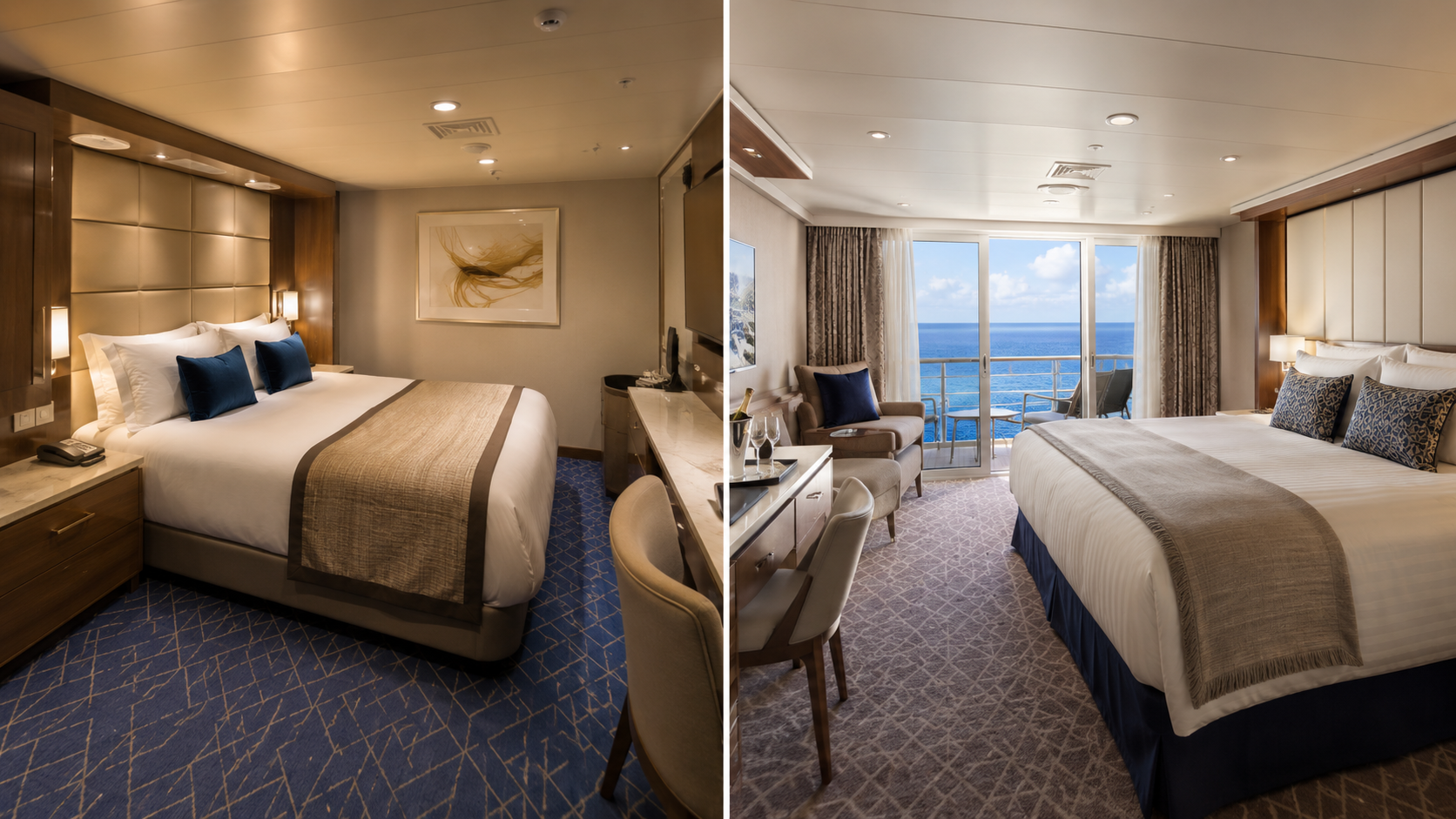
There are four cabin types — inside (no window, cheapest), oceanview (sealed window, natural light), balcony (private veranda, the big price jump), and suite (most space plus perks). None is objectively best. The right one comes down to a single question: how much daylight time will you actually spend in the room?
Port-heavy trip where you're ashore until evening? An inside cabin is smart, not cheap. Sea-day-heavy or scenic route like Alaska? A balcony earns every dollar. This guide — part of our New to Cruising guide — gives you a decision tool by traveler type, the honest catch behind each cabin, and where cabin choice overlaps with seasickness and budget.
The four cabin types, honestly
Here's the comparison the booking engines won't lay out plainly — what you actually get, who each suits, and the catch they bury in the fine print. Skim it, then use the decision tool below and read the deeper notes.
| Cabin type | What you get | Best for | The honest catch |
|---|---|---|---|
| Inside | No window, smallest footprint, the lowest fare on the ship. | Budget-minded and port-heavy cruisers who only sleep and shower in the room. | Pitch-black mornings (no natural light) and a boxed-in feel if small spaces bother you. |
| Oceanview | A sealed window or porthole — natural light, but no fresh air. | Those who want daylight and a horizon without paying for a balcony; the claustrophobia-prone on a budget. | The window doesn't open, and the cheapest ones are often obstructed view. |
| Balcony | A private outdoor veranda with floor-to-ceiling glass and fresh air. | Sea-day lovers and scenic itineraries (Alaska, fjords) where you're aboard in daylight. | The single biggest fare jump — and largely wasted on a port-intensive week. |
| Suite | The most space plus perks: priority boarding, more room, sometimes a concierge or butler. | Special occasions and travelers who value space and service over saving money. | A steep premium, and the perks vary wildly by line — read exactly what's included. |
Which cabin fits you?
Skip the generic advice. Pick the traveler type that sounds most like this trip, and you'll get our straight recommendation — including when we'd talk you out of spending more.
Which sounds most like you on this trip?
Tap a traveler type to see our pick.
Inside cabins: smart, not just cheap
The inside cabin has an image problem it doesn't deserve. Yes, it's windowless and small. But on a port-intensive itinerary — most Caribbean sailings — you're off the ship from morning until late afternoon and only in the room to sleep, shower, and change. You're paying a premium for a window you'd barely look through. Plenty of seasoned cruisers book inside cabins by choice and put the savings toward excursions or a nicer trip overall.
Two honest downsides. First, inside cabins are genuinely dark — there's no daylight to wake you, so mornings can be disorienting (some lines now offer a virtual balcony, a real-time screen of the view outside, which helps). Second, if small windowless spaces make you uneasy, an inside cabin will amplify that; spend the modest step-up to an oceanview instead.
Oceanview: the underrated middle
Oceanview cabins get overlooked because they're neither the cheapest nor the most exciting, but they're the sweet spot for a lot of people: you get natural light and a horizon to orient by, without the balcony's price jump. The window is sealed — no fresh air — and the cheapest oceanview cabins are frequently obstructed view, with a lifeboat or structural piece partly blocking the glass. That obstruction is sometimes a minor trade for real savings and sometimes a dealbreaker, so always check the specific cabin number against the deck plan before you book.
Balcony: worth it, but only sometimes
A balcony is the most over-recommended cabin in cruising — and genuinely wonderful on the right trip. The deciding factor is daylight hours aboard. On a sea-day-heavy sailing or a scenic route like Alaska or the Norwegian fjords, that private veranda is where you'll spend hours: coffee at sunrise, watching the coastline slide by, fresh air without the crowds. It earns its premium easily.
"On a port-heavy Caribbean week, you're off the ship every day until late afternoon. That gorgeous balcony sits empty in daylight — you're paying for a view you're not there to see."
So match the cabin to the itinerary, not the brochure. If the math is tight, a balcony on a scenic cruise beats a suite on a port-packed one for most people. Cabin is usually the second-biggest lever on your total fare after trip length — for the full picture, see how much a cruise actually costs.
Suites: when the premium pays off
Suites are the least universal recommendation. The extra space is real, and on some lines the perks — priority boarding and tender access, a concierge, specialty dining, a dedicated sun deck, occasionally a butler — genuinely smooth the trip. But the premium is steep, and "suite" means very different things across lines: a junior suite on a mainstream ship is closer to a large balcony cabin than to the full-suite perks you might be picturing. Suites pay off for special occasions, for travelers who value space and service over price, and on luxury lines where the gap to a balcony is smaller. Otherwise, the money usually buys more happiness spread across a better itinerary or more excursions.
The sub-types worth knowing before you book
Beyond the four main categories, a handful of booking terms quietly change what you pay and get. Knowing them keeps you from a nasty surprise — or wins you a bargain.
- Obstructed view — an oceanview or balcony with the view partly blocked; discounted, and worth it if the obstruction is minor. Check the deck plan. (Full definition: obstructed view cabin.)
- Guarantee (GTY) rate — you book a category and let the line assign the exact cabin later, usually at a discount. You might get a free upgrade or a less desirable location. Good for flexible budget travelers. (See guarantee cabin.)
- Virtual balcony — a floor-to-ceiling screen showing a live outside view in an inside cabin; a clever middle ground on lines that offer it. (See virtual balcony.)
- Connecting and family cabins — adjoining rooms with an internal door, the practical pick for families who want kids close but not on top of them.
If any other piece of cabin or ship jargon trips you up, the cruise glossary defines it all in plain English.
Cabin choice and seasickness
If motion is a worry, cabin location matters more than cabin type. The steadiest cabins are low and midship, near the ship's pivot point; higher decks and cabins toward the bow or stern move more. An oceanview or balcony helps too, because seeing the horizon settles your inner ear in a way a windowless inside cabin can't. Cabin choice is the single most effective thing you can do about motion before you even board — we go deep on it in will I get seasick on a cruise and the dedicated best cabin for avoiding seasickness, and the related question of the best deck on a cruise ship often gets decided at the same time.
Before you book the cabin
Cabin is one of three first-cruise variables that interlock: the line you choose sets the ship and the cabin styles available, the itinerary length and type decides whether a balcony is worth it, and the cabin itself follows from both. Lock the line and the itinerary first, then the cabin almost picks itself. When you're ready to compare actual rooms — square footage, balcony depth, deck position — you can look up cabin categories and deck plans on specific ships.
Frequently asked questions
What is the difference between inside, oceanview, balcony, and suite cabins?
An inside (interior) cabin has no window and is the smallest and cheapest. An oceanview cabin adds a sealed window or porthole for natural light but no fresh air. A balcony cabin adds a private outdoor veranda with floor-to-ceiling glass — the single biggest jump in both price and experience. A suite is the largest category and bundles perks such as priority boarding, more space, and sometimes a concierge or butler, at a steep premium. The right choice depends far more on how you travel than on which is objectively best.
Is an inside cabin on a cruise okay?
Yes — for many cruisers an inside cabin is the smartest choice, not a compromise. If your itinerary is port-heavy and you only sleep and shower in the room, you're paying for a window you barely use. The savings can fund excursions, dining, or simply a cheaper trip. The two real downsides are total darkness in the mornings (there's no natural light to wake you) and a boxed-in feeling if you're sensitive to small, windowless spaces. If either bothers you, step up to an oceanview.
Is a balcony cabin worth the extra cost?
It depends almost entirely on how much time you'll spend aboard during daylight. On a sea-day-heavy itinerary or a scenic route like Alaska or the Norwegian fjords, a balcony is genuinely worth it — private fresh air and a view you'll actually use for hours. On a port-intensive Caribbean week where you're off the ship every day until late afternoon, a balcony is largely wasted, and that money is better spent elsewhere. Match the cabin to the itinerary, not to the brochure photo.
What is an obstructed view cabin?
An obstructed view cabin is an oceanview or balcony cabin where something outside — usually a lifeboat, a structural support, or part of the ship's superstructure — partly blocks the view. Lines sell these at a discount, and how much the obstruction matters varies a lot: a partial lifeboat at the bottom of the glass is a minor trade for real savings, while a fully blocked window defeats the purpose. Always check the specific cabin number against a deck plan before booking one. See our full definition of an obstructed view cabin.
Which cabin is best for avoiding seasickness?
Cabin location matters more than cabin type for motion. The steadiest cabins are low and midship — near the ship's center of gravity, where the rocking is least pronounced. Higher decks and cabins toward the bow (front) or stern (back) move more. If you're prone to seasickness, prioritize a low, midship location and, ideally, an oceanview or balcony so you can see the horizon, which helps your inner ear settle. For the full breakdown, see our guide to seasickness on a cruise.