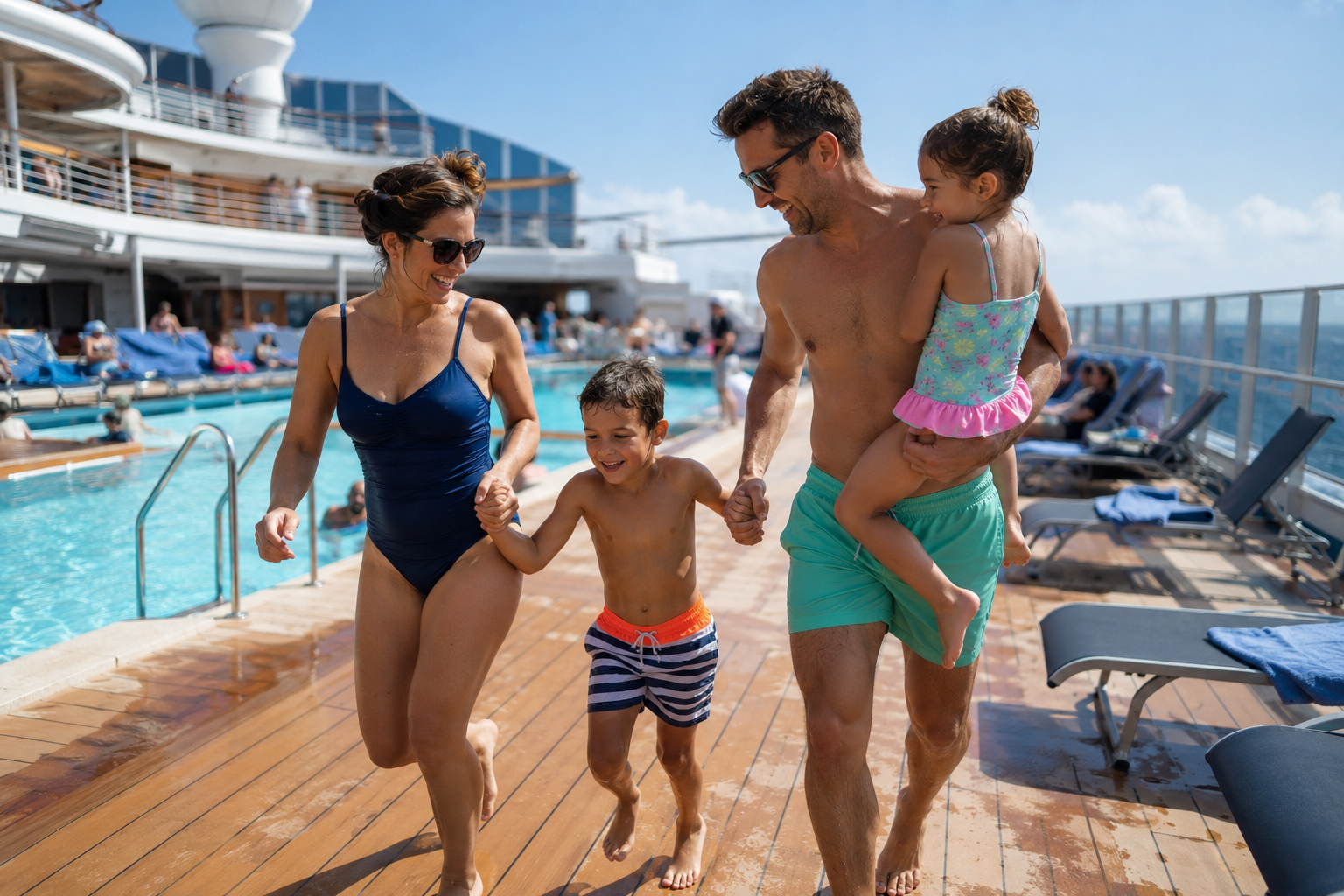
Cruising with kids is genuinely easier than most family vacations — once you clear two thresholds: your child is at least 6 months old to board, and at least 3 and potty trained to use the included kids club. Below those lines, a cruise still works, but it leans on you and a paid nursery rather than the free programming that makes cruise vacations such a deal for families.
Get the age fit right and the math is hard to beat: one price covers the hotel, the meals, the entertainment, and a supervised club where the kids beg to stay while you actually relax. This guide — part of our New to Cruising guide — walks through it age by age, compares the kids programs line by line, and flags the rules first-timers trip over.
The four rules that shape the whole trip
Before you pick a ship, four policies decide what your family's cruise will actually look like. They're consistent enough across the major lines to plan around, and they matter most for the youngest passenger in your group.
Sources: published age and youth-program policies from Royal Caribbean, Carnival, Disney, Norwegian, and MSC. Cutoffs vary by line and itinerary — confirm yours when you book.
Two of these surprise first-timers. The first is that a baby in diapers, or any child who isn't toilet trained, cannot use the main pools — that's a U.S. public-health rule, not a line quirk, and we cover it in detail below. The second is that the wonderful, free kids club has a hard floor at age 3 and potty-training; under that, your options are a paid nursery (only some ships have one) or doing it yourself. Everything else flows from your kids' ages, so let's go age by age.
Cruising with kids, age by age
The single most useful thing to know is that a cruise is a very different trip depending on how old your kids are. Here's what to expect at each stage, and the honest verdict on how smooth it'll be.
The trip leans on you (and the nursery)
Most lines welcome babies from 6 months old, and the contained, everything-in-one-place nature of a ship genuinely suits little ones. But this age can't use the regular kids club or the main pools. Your real childcare option is the ship's nursery — a paid, per-hour drop-off service that Disney, Royal Caribbean, and a few others run for roughly 6 to 36 months. Spots are limited and book up fast, so reserve on day one. Pack what you'd pack for a hotel-room baby: most lines provide a crib on request, and many sell or stock diapers and wipes onboard, but don't count on your exact brand.
Verdict: Doable and fun — but plan it as a trip with a baby, not a break from one. The nursery is your lifeline; book it early.
The free kids club unlocks — if they're potty trained
This is the age the cruise starts paying you back. Once a child turns 3 and is reliably out of diapers and pull-ups, they can join the complimentary kids club, where trained staff run crafts, games, and themed play in a space built for their age group. Suddenly you get pool time, a quiet dinner, or simply a coffee in peace. The honest caveat: separation anxiety is real at this age, and the first drop-off can be teary. Most clubs hand you a pager or text your phone if your child wants you, which takes the edge off.
Verdict: The sweet spot begins — provided potty training is solid. If it's borderline, wait or plan around the splash zone.
Arguably the best age to cruise, period
Old enough to throw themselves into everything, young enough to find all of it magical. This is the age the big mainstream ships are designed for: waterslides, ropes courses, rock walls, surf simulators, arcades, and a kids club they'll often choose over hanging out with you. They can usually sign themselves in and out with your permission, eat their weight at the buffet, and come back buzzing about a scavenger hunt. Sea days, which can drag for adults, are pure heaven for this group.
Verdict: Peak family cruising. Pick the ship with the most onboard activities and let them loose.
Freedom, in a place you don't have to worry about
Teens are the age parents assume won't like a cruise and are often wrong. A ship gives them exactly what they want — independence to roam with new friends — inside a safe, contained, alcohol-gated environment you don't have to police. Dedicated teen-only lounges, late-night activities, sports, and parties run separately from the little-kid club. The trade is that some teens find a 7-night cruise short on others their age on quieter sailings; busy summer and holiday cruises on big ships fix that.
Verdict: Better than you'd expect — especially on a large, busy ship with a strong teen scene.
Kids programs and age rules, line by line
This is the comparison no AI summary and no single Reddit thread reliably pulls together: how the major mainstream lines actually structure their youth programs, where the age cutoffs fall, and the one thing that makes each line's family offering distinct. Read across your child's age; read down for the line that fits.
| Line | Min. age to sail | Nursery (under 3, paid) | Kids club (free, ages & name) | The family hook |
|---|---|---|---|---|
| DisneyThe gold standard | 6 mo (12 mo on longer voyages) |
Yes — "It's a Small World" nursery for under-3s | Oceaneer Club & Lab, ages 3–12; teens get Edge (tween) and Vibe (teen) | Unmatched theming and characters. You pay for it, but nothing else comes close for young kids. |
| Royal CaribbeanBest all-rounder | 6 mo (12 mo for 3+ sea days/crossings) |
Yes — Royal Babies & Tots, 6–36 mo | Adventure Ocean, ages 3–11/12 (newer ships add an AO Babies group); teen lounges 12–17 | The most onboard activity — waterslides, surf simulators, rock walls. A great fit for active big kids. |
| CarnivalThe value pick | 6 mo (12 mo for 2+ consecutive sea days) |
Yes — drop-off nursery on most ships | Camp Ocean, ages 2–11 (Penguins/Stingrays/Sharks); Circle "C" 12–14, Club O2 15–17 | Casual, fun, affordable. Note Camp Ocean starts at 2 — but pool and potty rules still apply. |
| MSCBudget & kids-sail-free | 6 mo (varies by itinerary) |
Yes — Baby Club (0–3), LEGO partnership | Mini Club 3–6, Junior Club 7–11; Young Club 12–14, Teen Club 15–17 | Kids 18 & under often sail free in a parent's cabin (you still owe taxes, fees, gratuities). |
| NorwegianFlexible & freestyle | 6 mo (12 mo on some routes) |
Limited — Guppies program for infants on select ships | Splash Academy, ages 3–12; Entourage for teens 13–17 | No fixed dining times — eat when the kids melt down, not on a schedule. Frequent "Free at Sea" perks. |
Program names, age bands, and nursery availability vary by ship and can change — newer and larger ships generally have the most family infrastructure. Confirm specifics for your exact ship and sailing before booking.
A few patterns are worth pulling out. Every mainstream line draws the free-club line at age 3 and potty-trained; the differences are at the edges — whether there's a nursery for younger children, and how rich the teen scene is. Luxury and adults-leaning lines (think the small-ship and river brands) often have little or no kids programming at all, which is the point of them — if you want a quieter sailing, see our take on the cruises that lean adult. For a fuller breakdown of how the brands differ beyond their kids clubs, our guide to the best cruise lines for first-timers goes line by line.
The pool & potty rule first-timers miss
If you remember one thing from this guide, make it this, because it derails more family cruises than anything else: children in diapers or swim diapers are not allowed in the main pools or most hot tubs. This isn't a line being difficult — it's a U.S. public-health regulation that applies fleet-wide, and the crew enforces it.
What that means in practice:
- Not potty trained? Your child is limited to the ship's dedicated splash zone — a shallow, swim-diaper-friendly play area that bigger family ships provide, but smaller and older ships may not. If a splash pad matters to you, check that your specific ship has one.
- The kids club has the same wall. To join the complimentary club, a child generally must be 3 and fully out of diapers and pull-ups. Staff will check, and they don't bend it.
- "Almost trained" doesn't count. Plan for where your child actually is, not where you hope they'll be by sailing day. If training is in progress, build the trip around the nursery and splash area instead.
None of this should scare you off — it just changes which ship and which plan make sense for a toddler versus a 6-year-old. A little research on the lido (pool) deck layout of your ship goes a long way.
Booking the right cabin for a family
Where your family sleeps shapes the trip more than first-timers expect. A few things to weigh:
Everyone in one cabin, or two? A standard cabin sleeps up to four using a sofa bed and a fold-down Pullman bed — an upper berth that tucks into the ceiling, which most kids think is the best part of the trip. It's tight but workable for short cruises. For longer trips or bigger families, connecting cabins (two rooms joined by an interior door) give you separate space and a second bathroom without losing the kids next door — they're the most-requested family layout and sell out early. Our cabin comparison guide walks through inside vs. balcony vs. suite for families specifically.
The 21+ rule. At least one person 21 or older generally must sail in each cabin, so two cabins of kids next to each other usually isn't allowed unless an adult is registered in each — a quirk that catches larger groups off guard.
"Kids sail free" and third/fourth-guest deals. These are promotions, not permanent policy. MSC runs kids-sail-free most aggressively; other lines offer reduced or free fares for the third and fourth person in a cabin (usually the kids) on select sailings. Even when the fare is free, per-person taxes, port fees, and daily gratuities still apply, so a "free" child still adds to the bill. Watch for these when timing your booking — our guide to what a cruise really costs breaks down the full family math.
Which family are you? Pick the right ship
The biggest decision isn't the line — it's the kind of ship. Big, activity-packed megaships and smaller, calmer ships are almost opposite vacations, and the right one depends on your kids and your tolerance for crowds.
Go big & busy
Choose a megaship if…
- Your kids are 6–17 and want maximum stuff to do.
- You want the biggest kids clubs, waterslides, and teen scene.
- A busy summer or holiday sailing — more kids their age aboard.
- You don't mind crowds, lines, and a resort-at-sea feel.
- Royal Caribbean, Carnival, MSC, and Disney's larger ships.
Keep it calmer
Lean smaller & quieter if…
- You have a baby or toddler — less to chase, calmer pace.
- You'd rather have port-rich itineraries than onboard mega-amenities.
- Crowds and constant stimulation wear your family out.
- Just accept that kids clubs may be smaller or absent.
- Note: shortest 3–4 night sailings can skew party-heavy at night.
When you compare ships, match the ship to your youngest child, not your oldest. The best teen program on the seas is wasted on a toddler who can't use the pool, and a perfect toddler splash zone won't hold a 15-year-old for an hour. The youngest passenger sets the constraints — nursery, potty rules, pace — so build the trip around them and let the older kids enjoy the upside.
Our honest take
A cruise is the rare vacation where the kids have the time of their lives and the parents come home rested — but only if you've matched the ship and the timing to your children's ages. Force a toddler onto a teen-oriented sailing, or skip the potty-training fine print, and you'll spend the week working around rules you didn't see coming. Get the fit right and it's the easiest family trip there is.
"Our honest take: cruising with kids is the best-value family vacation going — once they're 3 and potty trained. Below that, it's a nice trip that happens to have a baby on it; above it, it's the one where you actually get to relax. Book the nursery early, respect the pool rule, and pick the ship for your youngest."
Worried about more than just the kids? A family cruise raises its own logistics — our cruise packing list has a kids-and-baby section worth a look, and if you're expecting while you sail, see cruising while pregnant. Any unfamiliar terms — from muster drill to Pullman bed — are explained in plain English in our cruise glossary.
Frequently asked questions
What is the best age to take a child on a cruise?
There's no single best age, but the easiest age to cruise with is roughly 3 and up, once a child is potty trained. That's the threshold where the included kids clubs open up on every major line, which means real free time for parents and a structured day of activities for the child. Ages 5 to 12 are arguably the sweet spot: old enough for the kids club and most activities, young enough to be thrilled by everything. Babies and toddlers under 3 can absolutely cruise (most lines allow them from 6 months old), but they can't use the regular kids club or the main pools, so the trip leans more on you and on a paid nursery if the ship has one. Teens often love cruises too, thanks to dedicated teen lounges and the freedom of a safe, contained ship.
What is the minimum age to go on a cruise?
On most major lines, a baby must be at least 6 months old on embarkation day to sail. That minimum rises to 12 months for longer or more remote voyages — typically transatlantic crossings, repositioning sailings, and itineraries with several consecutive days at sea, where the ship is far from shore-based medical care. There's also a separate rule on the adult side: at least one person in each cabin generally must be 21 or older. Always check your specific line and itinerary, because the cutoffs vary by route, not just by line.
Do kids have to be potty trained for cruise kids clubs and pools?
Yes — this is the rule first-timers are most surprised by. To join the complimentary kids club, a child generally must be at least 3 years old and fully potty trained, with no diapers or pull-ups. For pools, U.S. public-health regulations prohibit children in diapers or swim diapers from entering the main and most other pools, regardless of age. Babies and toddlers who aren't toilet trained are limited to the dedicated splash zones some ships provide for swim-diapered children. If your child isn't potty trained yet, plan the trip around the nursery (if the ship has one) and the splash area, not the kids club and the big pools.
Which cruise line is best for families with kids?
Disney is the consensus best for families and prices accordingly — unmatched theming, character experiences, a nursery for under-3s, and a separation of younger-kid and older-kid club spaces. Royal Caribbean is the best all-rounder for active families, with the most onboard activities (waterslides, surf simulators, rock walls) and a strong Adventure Ocean program. Carnival is the value pick, casual and fun with a solid Camp Ocean. MSC is the budget-and-international choice and frequently lets kids 18 and under sail free in a parent's cabin. Norwegian suits families who want flexible dining and freedom. The honest answer is that the best line is the one whose ship matches your youngest child's age — a great teen program is wasted on a toddler, and vice versa.
Are kids clubs free on cruise ships?
The daytime and evening kids club for potty-trained children ages roughly 3 to 17 is complimentary on every major mainstream line — it's included in your fare and is the single biggest reason families cruise. What costs extra is the nursery for children under 3, which is a paid, per-hour drop-off service on the lines that offer it at all, and late-night group babysitting after the regular club closes. So the rule of thumb is simple: club for the potty-trained kids is free; babysitting for the little ones is not, and nursery spots are limited and book up fast.
Do kids sail free on cruises?
Sometimes. "Kids sail free" is a recurring promotion rather than a permanent policy, and the terms vary. MSC most often runs it, frequently letting kids 18 and under cruise free in the same cabin as two paying adults (you still owe taxes, fees, and gratuities for them). Other lines run periodic kids-sail-free or reduced third- and fourth-guest fares on select sailings and seasons. Even when the cruise fare is free, the per-person taxes, port fees, and daily gratuities are not, so a "free" child still adds a few hundred dollars to the bill. It's a real saving, just not a total one.