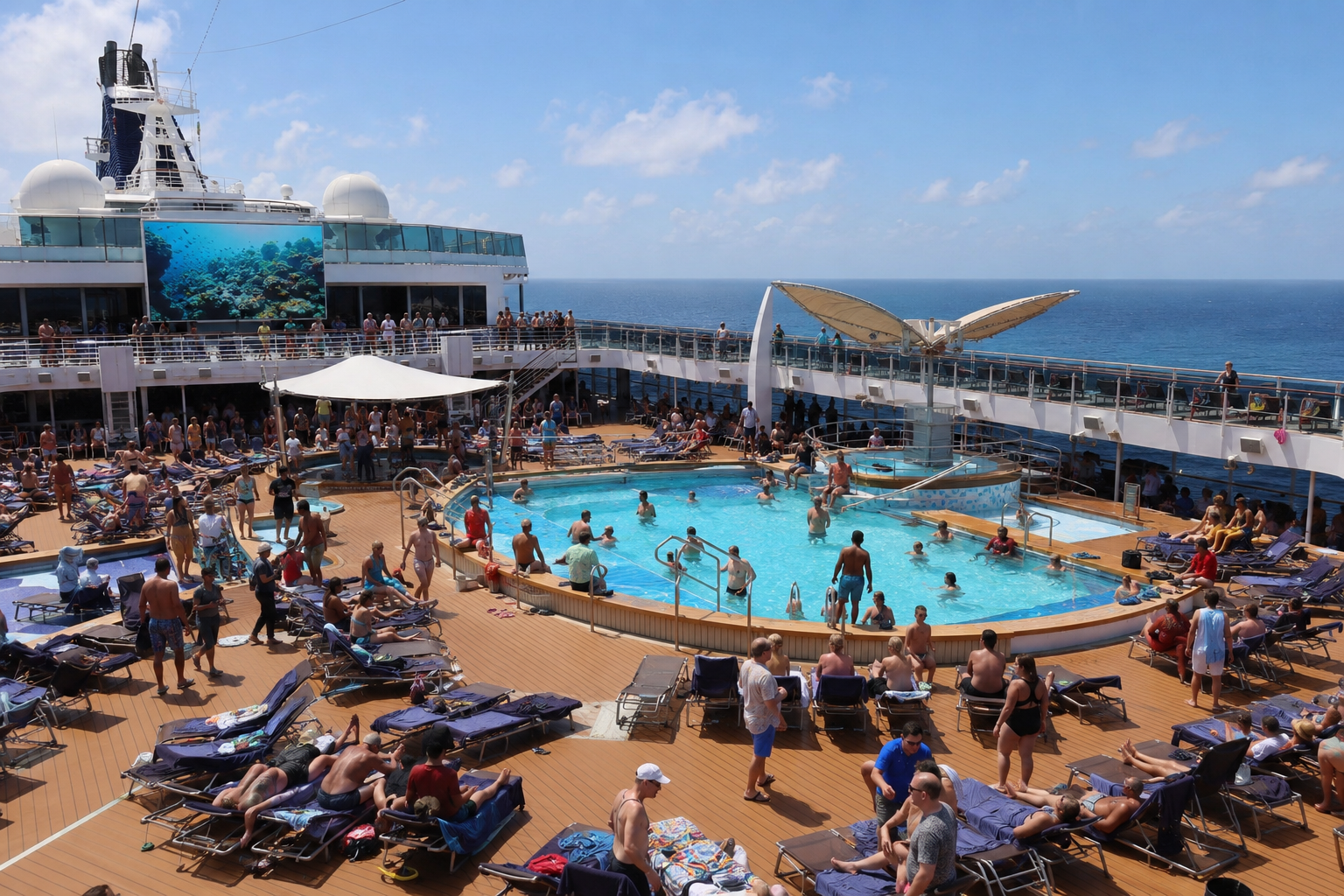
Almost certainly not — and most first-timers end the trip wishing they'd had more time, not less. A modern cruise ship runs like a floating resort with an hour-by-hour daily program that starts before breakfast and runs past midnight. Pools, sports decks, trivia, live music, theater, comedy, cooking demos, a casino, a spa: the only way to be bored is to ignore it all.
But we'll be straight with you, because the honest answer is what wins your trust over a generic "you'll never be bored!" There is one kind of traveler cruises can bore — and this guide, part of our New to Cruising guide, shows you a real sea-day schedule, spells out exactly who gets bored and why, and how to pick a ship and route that won't.
Why "bored" is usually the wrong worry
The fear makes sense if you picture a cruise as being stuck on a boat with nothing but ocean. The reality is closer to checking into an all-inclusive resort that happens to move. Every cruise line publishes a daily program — Royal Caribbean's Cruise Compass, Princess's Patter, Carnival's Fun Times — delivered to your cabin each evening and mirrored in the line's app. It lists, hour by hour, everything happening the next day, and on a big ship that's dozens of options at any given moment.
Most of it is included in your fare. The day's menu typically spans:
- Active stuff, free: pools and hot tubs, a gym, walking and jogging tracks, sports courts, and on larger ships rock-climbing walls, surf simulators, waterslides, zip lines, and mini-golf.
- Play and compete: trivia (the cult favorite), bingo, game shows, scavenger hunts, pool games, and dance or fitness classes.
- Learn and watch: cooking and cocktail demonstrations, enrichment talks, art auctions, and craft sessions.
- Evenings out: Broadway-style theater productions, comedy, live bands and pianists, the casino, nightclubs, and a movie under the stars.
- Quiet by choice: the spa and thermal suite, the library, an adults-only sun deck, your balcony, and a long unhurried dinner.
That last line matters as much as the first: the busy version of a cruise is optional. So is the calm one. You assemble the day you want.
A real sea day, hour by hour
Talk of "lots to do" is easy to wave away, so here's what a single sea day actually looks like on a typical large ship — the kind of schedule you'll find in the daily program. A sea day is the acid test for boredom, because there's no port to fill the hours. Notice the problem isn't empty time; it's choosing.
Read it back and the takeaway is obvious: even a day with no port is overbooked, not empty. The single habit that separates a full sea day from a flat one is reading the next day's program the night before and circling two or three things. People who feel bored on a cruise are almost always the people who never opened it.
Whether you're an introvert or an extrovert
The worry about boredom often hides a more specific question: is this trip built for someone like me? The reassuring answer is that a cruise flexes to both temperaments — they just use it completely differently.
Energized by people and buzz
If you're an extrovert…
- You're the target customer. Trivia teams, group classes, deck parties, and shared dinner tables give you a built-in social life.
- Choose a big, lively resort-style ship — more venues, more events, more people to meet.
- Open seating or a large shared table at dinner turns strangers into a week of friends.
- Boredom risk: close to zero. Your only problem is fitting it all in.
Recharged by calm and space
If you're an introvert…
- None of the organized fun is mandatory. Skip the trivia and you've lost nothing — a balcony, the spa, a quiet deck, and a good book are the cruise too.
- Lean toward a smaller or more premium ship and a port-rich itinerary over a giant party ship.
- Ask for a table for two, or use anytime dining to avoid a fixed group.
- Boredom risk: low, as long as you don't pick the loudest ship and then resent the noise.
The honest part: who actually gets bored
We'd rather tell you the truth than sell you a cruise. A small set of travelers genuinely can be bored — almost always a mismatch between the trip and the person, not a flaw in cruising. Find yourself in this table before you book.
| Which traveler are you? | Boredom risk | Why | The fix |
|---|---|---|---|
| The activity-lover | None | There's more to do than hours to do it. | Just read the daily program. A big ship is your playground. |
| The relax-and-recharge type | Low | Spa, deck, balcony, long meals — the calm version is fully stocked. | Book a balcony or oceanview cabin and let the busy stuff happen without you. |
| The "I hate organized fun" type | Moderate | If the ship is the activities, opting out can feel like missing the point. | Pick a port-heavy itinerary and a ship known for atmosphere over gimmicks. |
| The culture-first traveler | Real | You want deep immersion in places; a few hours per port can frustrate. | Choose itineraries with overnights and longer port stays, or a smaller expedition-style ship. |
| The wrong-ship picker | Self-inflicted | A quiet person on a party megaship, or a thrill-seeker on a sedate small ship. | Match the ship and route to how you like to spend a day — the whole ballgame. |
The pattern across every "real" risk: it's a mismatch you can avoid at the booking stage, not something inherent to being at sea.
Boredom on a cruise is almost never about the cruise — it's about picking the wrong ship and itinerary for the way you actually like to spend a day. Choose the ship to match your temperament and the route to match your appetite for ports, and "will I be bored?" answers itself before you've packed a bag.
What actually moves the needle: the ship and the route
Two booking choices do nearly all the work of deciding whether you'll be entertained, and getting them right is far more reliable than hoping.
The ship sets the ceiling on activity. A giant modern resort ship — think the newest Royal Caribbean, Carnival, MSC, or Norwegian flagships — is a wall-to-wall entertainment machine: waterparks, multiple theaters, dozens of bars. A small ship, a luxury line, an expedition vessel, or a river cruise deliberately trades all that for fine dining, enrichment, intimacy, and time ashore. Neither is better; they're built for different people. If you're unsure which suits you, our guide to the best cruises for first-timers and our how to choose your cruise itinerary walkthrough match ships to personalities.
The itinerary sets your port-to-sea ratio. This is the real boredom dial. A Caribbean or Mediterranean week that's in port most days rarely drags — you're somewhere new every morning. A long transatlantic repositioning crossing, by contrast, can string together five or more consecutive sea days, which is heaven if you love the ship and long if you don't. If you're testing the waters, a short 3- to 4-night sailing is a low-stakes sampler; the question isn't really the number of nights but how many of them have a port attached.
"Our honest take: in years of hearing first-timer worries, 'I was bored' is one of the rarest — and when we do hear it, it's nearly always someone who put a quiet soul on a party ship, or a city-break traveler on a five-sea-day crossing. Match the trip to the person and a cruise has the opposite problem: you run out of vacation before you run out of things to do."
Putting it together
Boredom isn't a risk you manage onboard so much as a choice you make at booking. Pick the ship that fits your temperament and a route with the right balance of ports and sea days, then simply read the daily program and the days fill themselves. If the deeper question under "will I be bored?" is really "is this whole thing worth it for me?", our honest look at whether a cruise is worth it tackles that directly. The other first-cruise nerves tend to cluster together — if a fear of tight spaces is part of it, see are cruise ships claustrophobic?, and if it's safety on your mind, our data-driven look at how safe cruise ships really are covers it. To see how much of the entertainment is already baked into your fare, read what's actually included on a cruise, and any unfamiliar terms are decoded in the cruise glossary. The reassuring bottom line: a well-matched cruise doesn't run out of things to do — you run out of time.
Frequently asked questions
Will I be bored on a cruise?
For the vast majority of first-timers, no — the more common complaint is that there is too much to do and not enough time. A modern cruise ship runs like a floating resort, with an hour-by-hour daily program of free activities from morning to past midnight: pools and sports decks, trivia and game shows, live music and Broadway-style theater, cooking demos, comedy, a casino, and a spa and gym. You only get bored if you ignore the daily program or if you are the specific kind of traveler who dislikes organized activity and wants deep cultural immersion instead. The fix for that is choosing the right ship and an itinerary with plenty of ports, not avoiding cruising altogether.
What is there to do on a sea day?
A sea day is the busiest day for onboard programming precisely because there is no port to fill the hours. A typical sea day offers a sunrise walk or gym session, fitness and dance classes, trivia and game shows, enrichment talks or cooking and cocktail demonstrations, pool games and live music by day, then a pre-dinner show, multi-course dining, an evening theater production, comedy, the casino, and a late-night party or movie under the stars. Larger ships add rock-climbing walls, surf simulators, waterslides, zip lines, mini-golf, and sports courts. Read the next day's program (delivered to your cabin each night and shown in the cruise line's app) and circle a few things — that one habit is the difference between a full day and a flat one.
Do you get bored on a cruise if you are an introvert?
Introverts often love cruising, but for the opposite reasons extroverts do. The social scene — trivia teams, group classes, parties — is entirely optional. You can read on a quiet deck, sit on your balcony with the horizon, spend an afternoon in the spa's thermal suite, find a hushed lounge or the library, and dine at a table for two. The thing to get right is the ship: a giant, action-packed resort ship can feel loud and crowded for someone who wants calm, while a smaller, more port-focused or premium ship suits a quieter trip better. Introverts are rarely bored on a cruise; they just curate a different version of it.
Are small cruise ships boring?
Not boring, but quieter by design. Small ships, luxury lines, expedition vessels, and river cruises deliberately trade waterslides and Broadway theaters for destination immersion, enrichment lectures, fine dining, and more time in port — often with overnight stays. If your idea of a great vacation is rock climbing and a casino, a small ship will feel slow. If it is exploring places with interesting people and good food, a big resort ship is the one that will feel hollow. Match the ship to how you actually like to spend a day; size is a style choice, not a quality ranking.
How long before a cruise gets boring?
It depends far more on the itinerary than the number of nights. A port-intensive week rarely drags because you wake up somewhere new every day or two. What can feel long is a run of consecutive sea days — common on transatlantic repositioning crossings or some longer voyages — where it is just you and the ship for days at a time. If you are unsure whether cruising is for you, a 3- to 4-night sailing is a low-risk sampler; if you already know you love sea days, length is rarely the problem. The boredom lever is the ratio of port days to sea days, not the total length.
What if I do not like organized group activities?
Then skip them — none of it is mandatory, and plenty of cruisers never set foot in a trivia session. Build your trip around the parts that are not organized fun: a port-heavy itinerary with independent shore exploration, long meals, a good book on deck, the spa, the gym, the pool, and your balcony. Choosing a more destination-focused itinerary and a ship known for atmosphere over activity does most of the work. The mistake is picking a giant entertainment-first ship and then resenting the entertainment; pick the trip that matches you and the organized activities become a thing you walk past, not a thing you endure.